- Developer: Nintendo
- Publisher: Nintendo
- Reviewed On: Nintendo Switch
- Available On: Nintendo Switch
If you told me at the start of the year that The Legend of Zelda: Tears of the Kingdom was going to be a game that I absolutely fell in love with, I probably wouldn’t have believed you. I felt that its predecessor Breath of the Wild was an enjoyable experience, but took issue with its blank canvas design which felt a bit too open and directionless for me. But that’s been flipped on its head with Tears of the Kingdom. By building on the concepts of adventure, creativity, and exploration that laid the foundation for the previous game, and amplifying them with a stronger sense of focus and direction, everything that I didn’t click with before has been vastly improved, making this not just one of the best games I’ve played this year, but one of the best games I’ve ever played period.
Picking up some time after Breath of the Wild, Tears of the Kingdom gets straight to the point. While exploring deep underneath Hyrule Castle, Link and Zelda discover the dormant body of the ancient Ganondorf whose revival begins almost immediately. The encounter finds Zelda transported back to ancient Hyrule, Link with a damaged Master Sword in the present, and the world itself physically altered. What follows is a search for answers in both the past and the present as you work to find a way to defeat Ganondorf.
It’s a much stronger story than the previous game had for a couple of reasons. In Breath of the Wild, the story was much more of a background element to your adventure throughout Hyrule, whereas here, it’s front and center from the get-go and remains there, even as you go off the golden path and get lost in the world. Just as important is the fact that the story in Tears of the Kingdom is far more interesting and exciting, even if it’s once again mainly told through memories from the past.
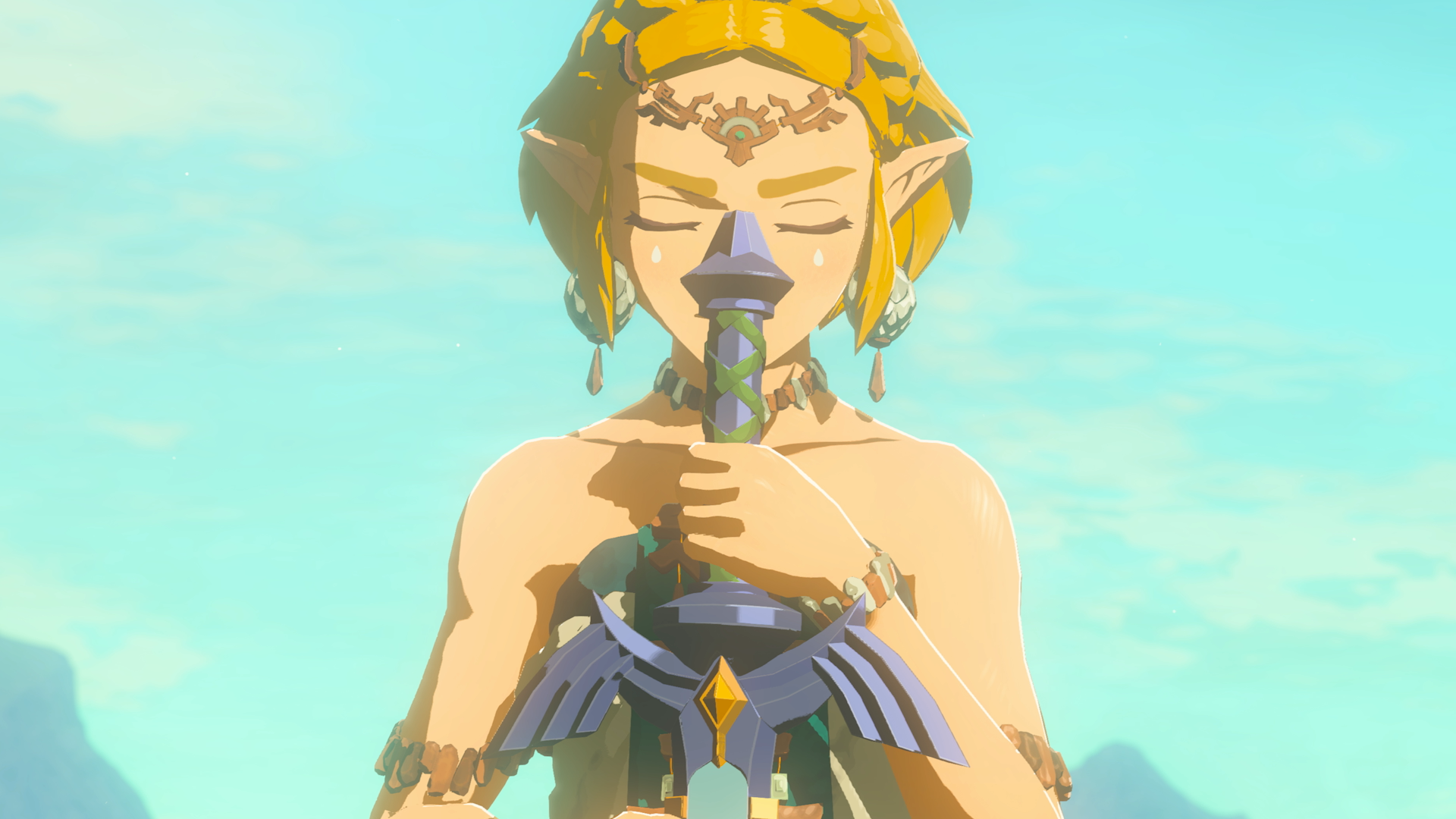
Previously, memories served as a way to give context to the state of Hyrule, but they never actually felt crucial to the story. Now called Dragon Tears, they’re actually integral to the plot and had me eagerly searching them out. It’s through these memories that we’re able to not only see what ancient Hyrule was like and learn about the mysterious Zonai people, but also witness Ganondorf’s rise to power as the Demon King, and discover what’s happening with Zelda. These events are more compelling than the memories in Breath of the Wild ever were, and because they directly inform Link’s actions in present-day Hyrule, I was highly invested in them.
In the present, you once again travel across the different regions of the world to find out the cause of different phenomena that have been occurring. This quest has you working with returning allies to save each region and discover how they’re connected to Ganondorf. Reuniting with fan-favorite characters like the Zora warrior Sidon and the Gerudo leader Riju is great, and minor characters from Breath of the Wild such as Tulin have been given bigger roles that make them more memorable this time around.
Progressing through the main quests essentially gives you two halves of the whole story, and as you put the pieces together you’re rewarded with moments that are epic, heartbreaking, wholesome, and uplifting. Tears of the Kingdom does drag a bit near the end of its story, as it feels like it wants to delay the inevitable with one final hunt for answers that are insultingly obvious, but the end result is well worth the trouble.
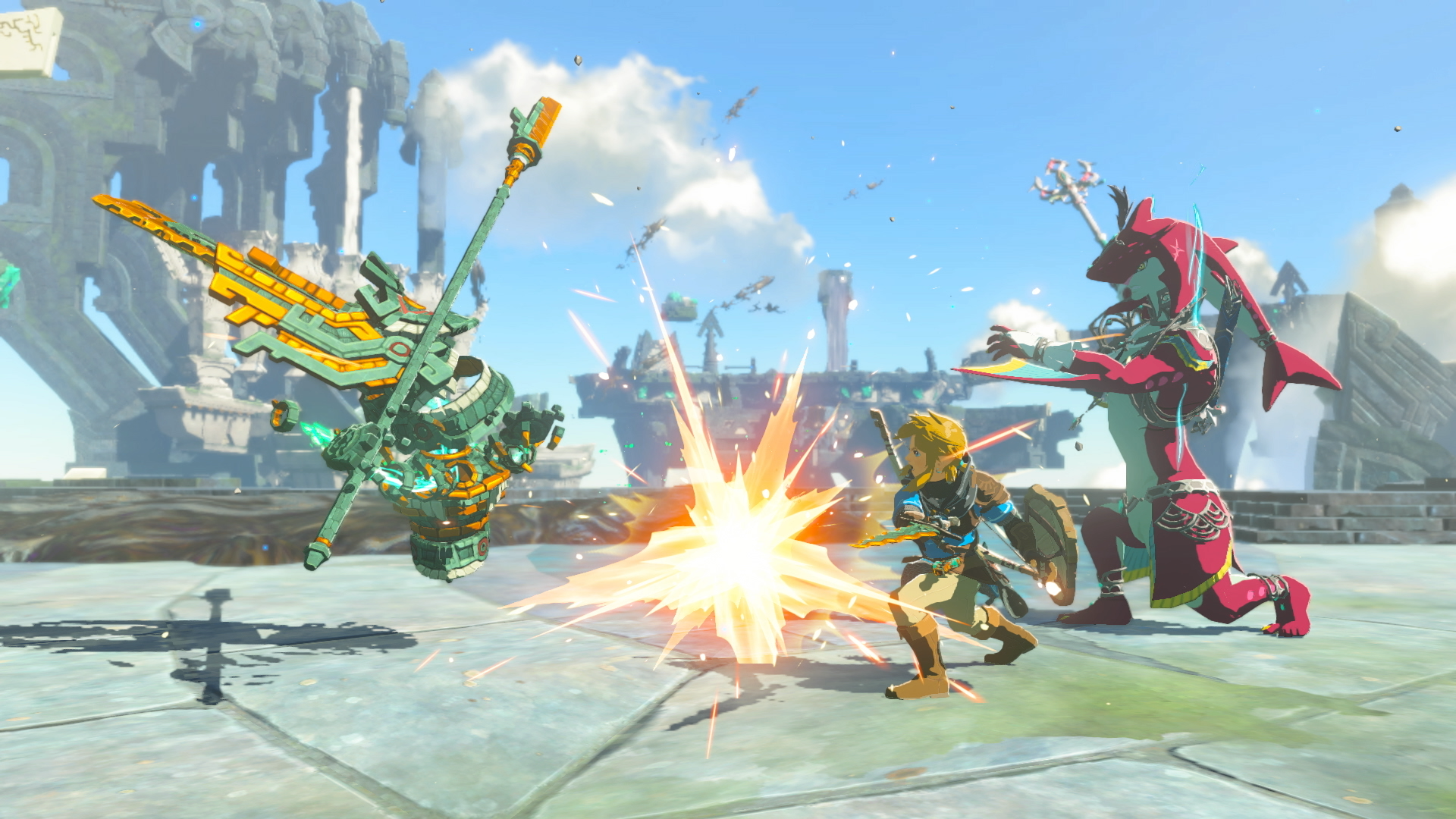
One key part of the main quest where the team seems to have taken in feedback is in regard to dungeons. The Divine Beasts were meant to fill that role in Breath of the Wild, and now Tears of the Kingdom introduces temples that provide a nice middle ground between the themed dungeons from classic Zelda games and the new gameplay approach that the series has adopted. While the structure of the temples is similar to that of the Divine Beasts, both in terms of reaching them and completing them, the temples are more involved than the Divine Beasts were. Their layouts tend to be more intricate, and although you still have the freedom to complete them in whatever order you want, the puzzles are a bit more focused this time around thanks to the presence of your fellow Sages.
Every element of the temples is based around their respective Sage, from the puzzles you have to complete to the boss fight at the end of them. They accompany you in each one and it’s cool being able to fight with them and make use of their special abilities. Moves such as Yunobo’s ability to charge ahead in a high-speed fiery ball, or Riju’s ability to bring down lightning wherever you aim are fun to use and are central to progressing through the temples. Overall, this focus gives each temple a strong, unique identity of its own, which is something that I greatly appreciated since the Divine Beasts were a bit too samey.
As for the bosses, these fights are much improved over the Ganon Blight encounters. Since they’re built around each Sage and their ability, the fights are more fun and engaging than the battles in Breath of the Wild. Your allies can be a bit annoying though since in order to initiate their ability you have to be right next to them, and I found that they tended to run just out of my range when I needed to use them. This wasn’t that annoying when making my way through the temple, but it was frustrating during the boss fights when I needed them at all times.
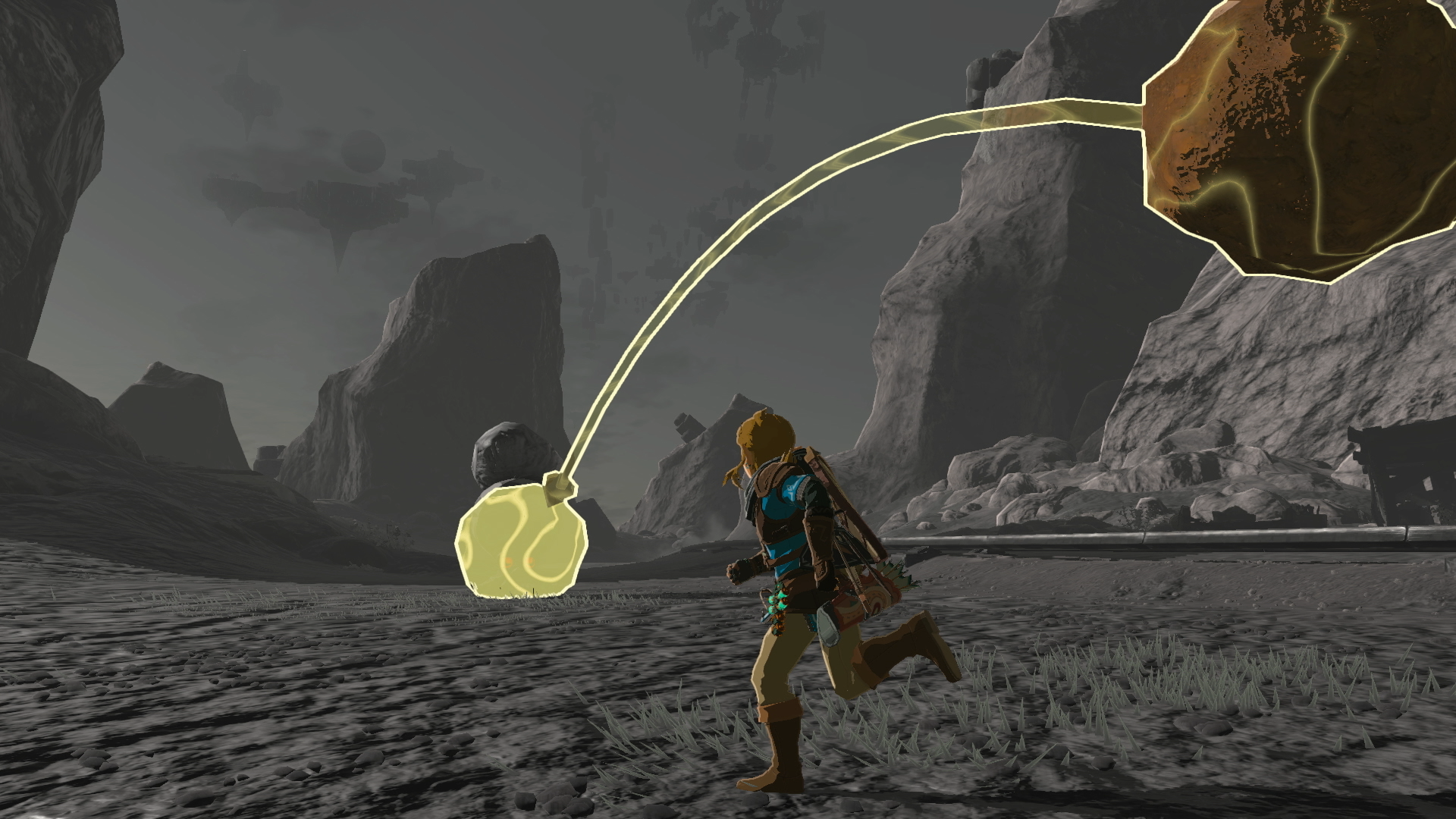
Just like before, everything in Tears of the Kingdom is designed around your four core abilities. You have Recall, which reverses time on any object you choose; Ascend, which lets you easily climb through any solid surface above you; Fuse, which allows you to combine nearly any item with your weapons and shields; and Ultrahand, with which you can grab and stick practically any object in the world together. Each of these Zonai abilities is a game-changer as they made me view everything in the world in a completely different way, from puzzles and combat to even simple traversal.
Whenever pesky Octoroks would take potshots at me from the water, I would use Recall on their rocks to give them a taste of their own medicine. And I can’t stress enough how much of a relief it is to be able to use Ascend to leave caves or reach the peaks of mountains with just the press of a button. As great as these abilities are, they don’t hold a candle to the revelations that are Fuse and Ultrahand.
The item degradation system was a major point of contention for many in Breath of the Wild, and it’s still a thing in Tears of the Kingdom, but the Fuse ability manages to alleviate many of the system’s annoyances by restoring the health of fused items. So if you have a weapon or shield that you like, you can extend its life some by fusing it with another object, be that another weapon, shield, or anything else. This also has the added benefit of increasing the strength of your weapon or shield, and depending on the fused item, giving them a special effect of some sort. If you want to stick a bomb onto your weapon, you can do that. Or if you want to get a bit weird and experiment, you can fuse a mushroom to a greatsword and create a weapon that’ll literally send enemies flying. In the case of arrows, Fuse is how you’ll get your different elemental arrows, explosive arrows, and other unique projectiles.
Ultrahand is the star of Tears of the Kingdom with its power to move objects and stick them together being key to most aspects of the game. As such, it’s the poster child for Tears’ central ideas of player creativity and experimentation. Using Ultrahand, you can make just about anything you can think of, with the only real limits being the physics system and your imagination. Sometimes that meant making a long bridge out of whatever was nearby to get around an obstacle, and other times it meant making whatever structure I could think of to help hold up a loyal worker’s job sign.
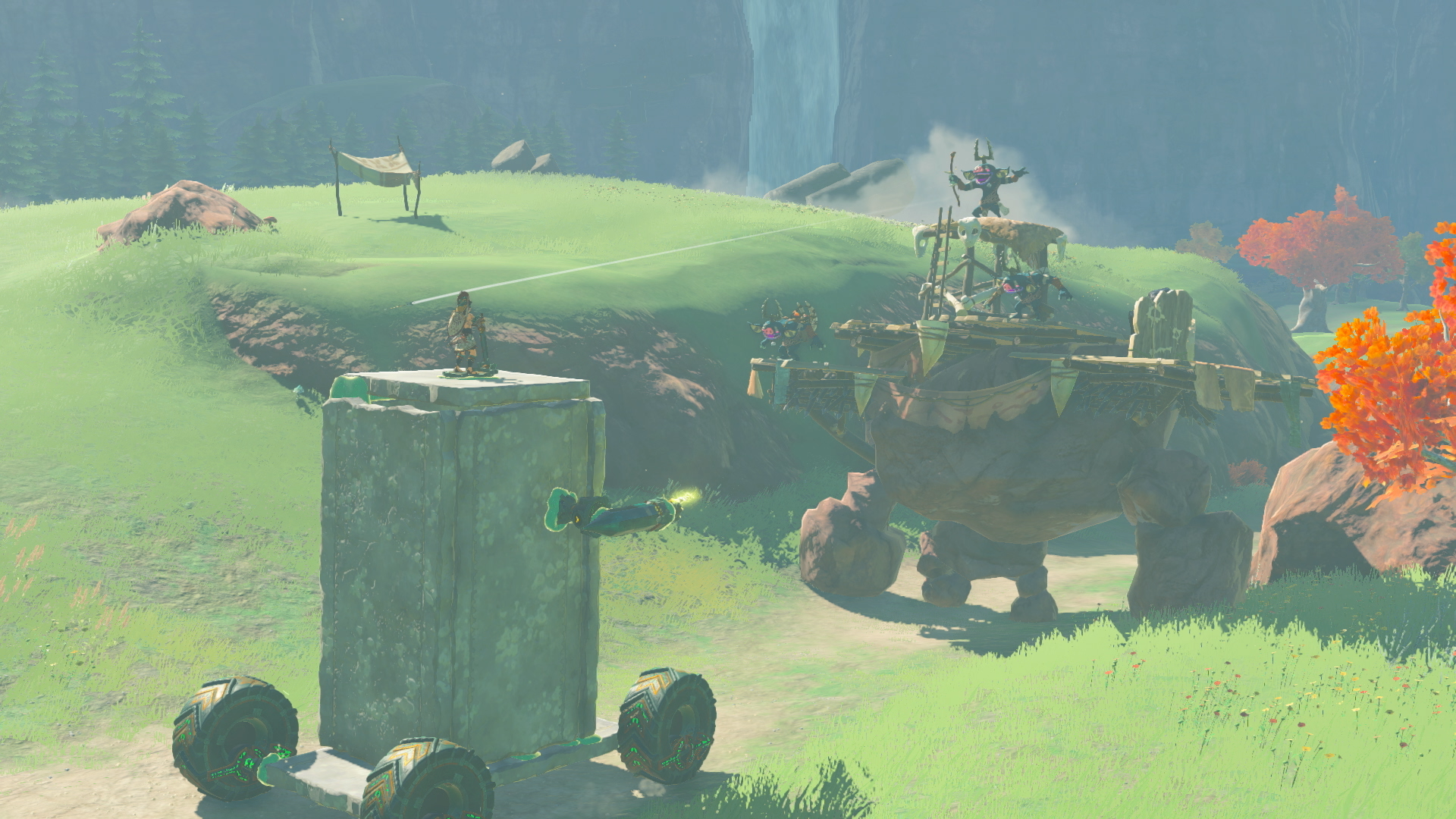
Going hand-in-hand with these abilities are the new Zonai tools. These items can range from wheels, sleds, and rockets, to hydrants, lasers, and portable cooking pots, and they work in sync with your Fuse and Ultrahand abilities, fueling any creative potential that one may have. My mind isn’t the most creative, so I didn’t get too wild with the things I made, but the fact that you can is extremely exciting. Your creations run on energy that’s supplied by Zonai batteries you have, with more intricate creations using more energy, so you can’t use them forever. You can permanently increase the energy your batteries have, though it requires a fair amount of mining resources so I didn’t do this until near the end of my adventure. I never felt restricted though since I was able to get by just fine using only one battery, and if I never needed more energy, I would temporarily increase it with any Zonai charges I had.
The Zonai abilities are amazing and really shine when you get creative with them in different scenarios. This is something that people did in Breath of the Wild, but I felt that you had to go out of your way to get creative in that game as opposed to it coming naturally. By contrast, Tears of the Kingdom actively encourages you to think outside the box with your abilities, so I never once felt like I was doing something I didn’t want to just for the sake of differentiation.
Let’s take combat for example. It’s fundamentally the same as in Breath of the Wild with largely the same enemies, but the ways in which you can implement Link’s new abilities have elevated it. Some enemies, such as the new Flux Constructs, outright require you to make use of your different Zonai abilities in order to take them down, making for some really fun fights. I could try jumping on a Talos and climbing its back to get on top of it, or I could use Recall on the stones it throws to stun it and climb without issue. I could also run underneath it and use Ascend to get on top in a flash. Sticking multiple explosives to each other with Ultrahand was a great way to get the drop on sleeping enemies, or even against ones that were charging right at me. I could even use Fuse to make a Mirror Shield that momentarily stuns enemies that you point its light at or a sword that spews flames with each swing.
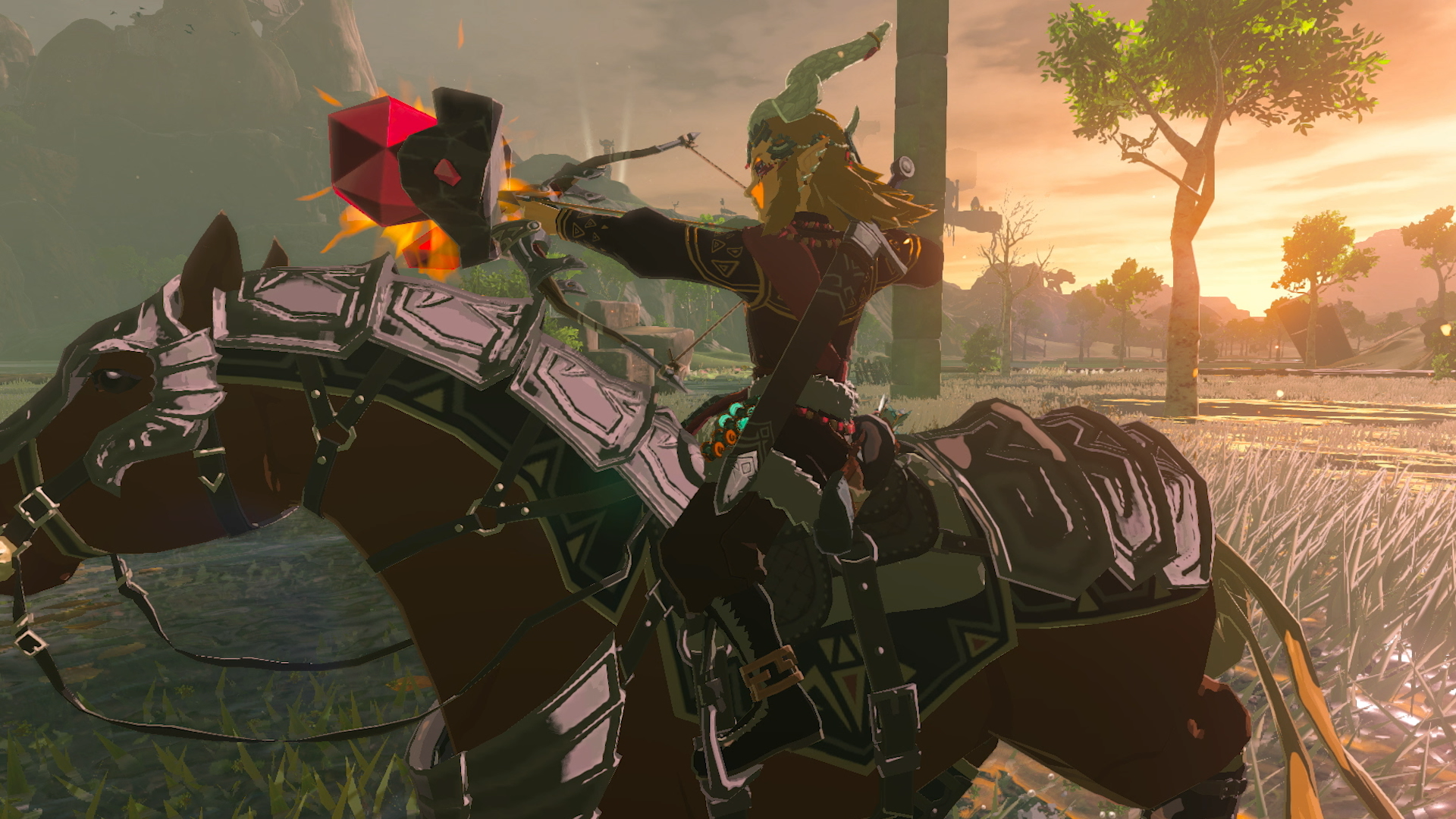
This also applies to non-combat scenarios when you’re out in the open world. Koroks return in mostly the same format as before, but this time around there are some that need to be brought to a friend that’s kind of far away. Sometimes I’d take the easy route and just use Ultrahand to attach them to my horse, dragging them all the way there. But other times I would get a bit creative with my strategy, whether that meant using a makeshift raft or attaching them to a hot-air balloon out of necessity, or making a plane to fly them over just for fun.
Even just with basic exploration, I would have fun trying to get creative with Ultrahand and my Zonai tools as I tried making vehicles to get around faster than on my horse. One of the first things I did upon making it to Hyrule was spend close to 30 minutes making a car that was powered by a fan and a rocket. Did it work? Upon activation, it promptly flew into a bunch of trees and didn’t move anymore, so not exactly, but it was fun just getting to that point.
Shrines make their return and I found them to be more fun than in the last game, partly because they seem more straightforward than before, but largely because of how they continue to push the creativity that Tears of the Kingdom wants you to engage in with your abilities. There are your simple, easy-to-solve shrines, harder and more complex shrines, basic training ones, and then combat challenges. One shrine I was in required me to reach a higher level in order to get to the end. While I could see what I needed to do with the items in front of me, I couldn’t quite figure out how to make things work. So I got creative and used a mixture of Ultrahand, Recall, and Ascend in order to reach the necessary height and complete the shrine.
In another, I needed to get a metal ball across a body of water using a rolling cart. I’m sure there was a very specific solution that the team had in mind, but I put the cart on the rails that were in the water and rode it to the other side. It might not have been the “correct” solution, but it was a solution nonetheless and I liked that I was able to do that, not just in this shrine, but in others as well.
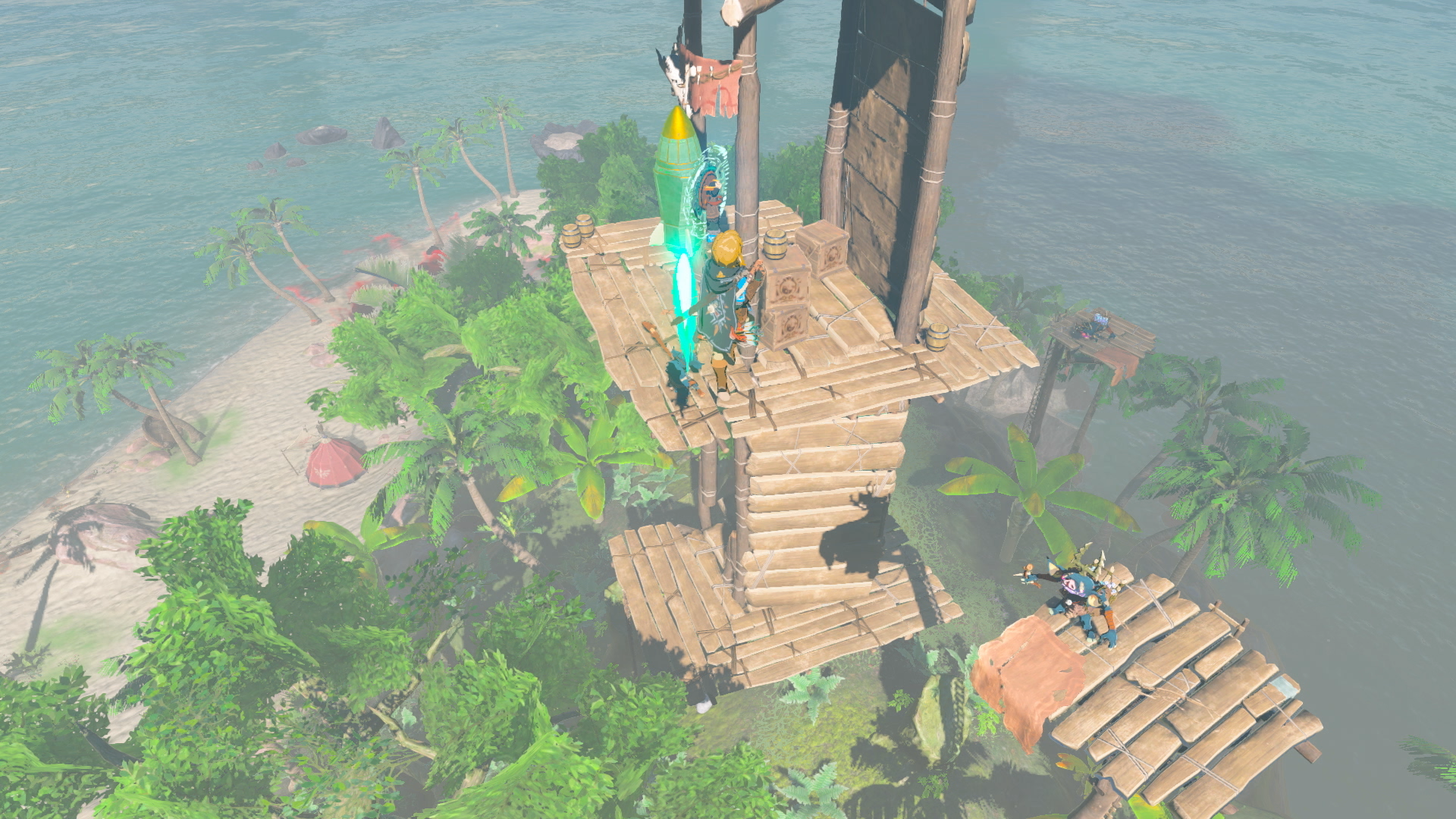
The abilities in Tears of the Kingdom are a lot of fun to use; so much so that they make Breath of the Wild seem basic and barebones in hindsight. Because of this, I never saw it as a waste of time to go out of my way with my solutions to problems since Tears of the Kingdom wants you to experiment and get creative with the tools it hands you, even if your plan fails or makes completing a simple task harder than it should be. No matter if it was with a basic car, a failed attempt at making a motorcycle, or making a plane capable of bombing unsuspecting enemies underneath it, the tools that Tears of the Kingdom provided made engaging with its world a true delight.
Hyrule was a large world in Breath of the Wild, but I felt like it was fairly empty and lifeless which caused me to not feel the strong urge to just explore and get lost in it. As with everything else in Tears of the Kingdom, that’s far from the case now. While the map is the same, the world itself is very different, with changes being made to the surface, and a massive increase in scale with the introduction of the Sky Islands and the Depths.
On the surface, familiar locations have an air of newness to them that makes them unfamiliar. The once-empty space just outside the front of Hyrule Castle is now home to Hyrule’s base of operations for researching what’s happening all over; Rito Village and the surrounding area is a frozen tundra; lava no longer covers Death Mountain making it safe to traverse. Changes like these make exploring these areas feel completely different and had me looking forward to finding out what else was altered in the world. Caves and wells across the surface are also home to a litany of new secrets just waiting to be discovered, and just as in Breath of the Wild, towers return as the way in which you reveal new regions on your map.
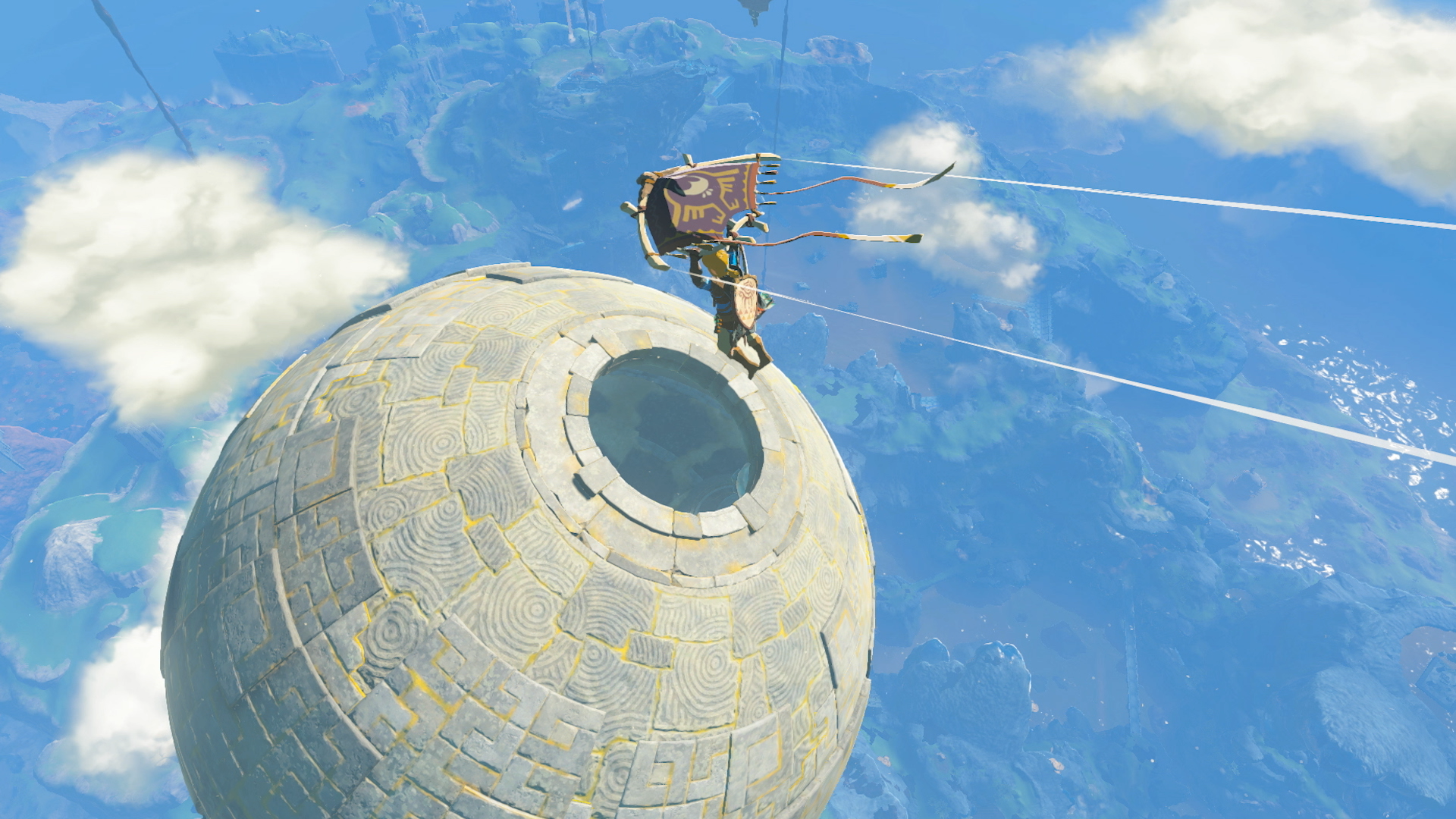
Above the surface are the brand-new Sky Islands. These pieces of land are littered across the different regions of the world and can be reached seamlessly from the surface by either using Recall on a chunk that fell from the sky or launching out of a tower. Whenever I was in the sky, I was constantly in awe at the technical wizardry that allowed the Sky Islands to be an ever-present part of the world. Looking out over Hyrule and seeing the entire map from high up as I flew over it all or sky-dived back down to the ground gave me a feeling of wonder every single time.
As cool as the Sky Islands are in concept, I feel like they’re disappointing in execution. You start Tears of the Kingdom on the Great Sky Island which serves as the initial tutorial space. It’s a large, expansive area with multiple interconnected spaces to explore, and plenty to see and do. It’s a great proof-of-concept and had me excited to explore other Sky Islands just like it, but unfortunately, it’s an idea that’s not capitalized on since there aren’t any. The vast majority are small, scattered islands that don’t have much to them outside of potentially a shrine, a boss, or some Zonai items. While there are some that are more involved than your basic Sky Island, these are the exception, not the rule, and even then they’re still fairly small and contained. This sameness led to me not engaging with the Sky Islands much past my initial discovery of each new section on the map unless I needed to make a quick trip to get something from them.
Deep beneath the surface are the Depths, and they’re probably my favorite area to explore. The Depths are fascinating as they’re essentially an entire second map with its own secrets to uncover. It’s a terrifying experience though as the entire area is completely shrouded in darkness, so you have to manually light the way as you explore. I loved this as it made traversing the Depths more engaging and gave me a sense of discovery that’s unmatched, causing every trip down there to feel like I was on an actual adventure where proper planning and careful movement were required. I never knew what I might find but I was always excited to see what lay in store for me down there. Lightroot Trees are the equivalent of towers in the Depths and light up the surrounding area, making finding them a welcome relief.
There’s also the fact that the Depths are more dangerous than anywhere else in Hyrule. The environment is covered in Gloom, a mysterious substance that takes away usable hearts if you touch it, making it important to watch where you’re going. Enemies down here are also stronger and covered in Gloom, and getting hit by any of them will also cause you to lose hearts, making combat an even bigger risk than it normally is. Lost hearts aren’t gone forever since they can be regained by going to Lightroot Trees, returning to the surface, or eating the proper meal. When you combine the high danger level with the mystery of the Depths and the ominous music that plays the whole time, you get a recipe for a thrill-seeking expedition that I absolutely relished whenever I was down there.
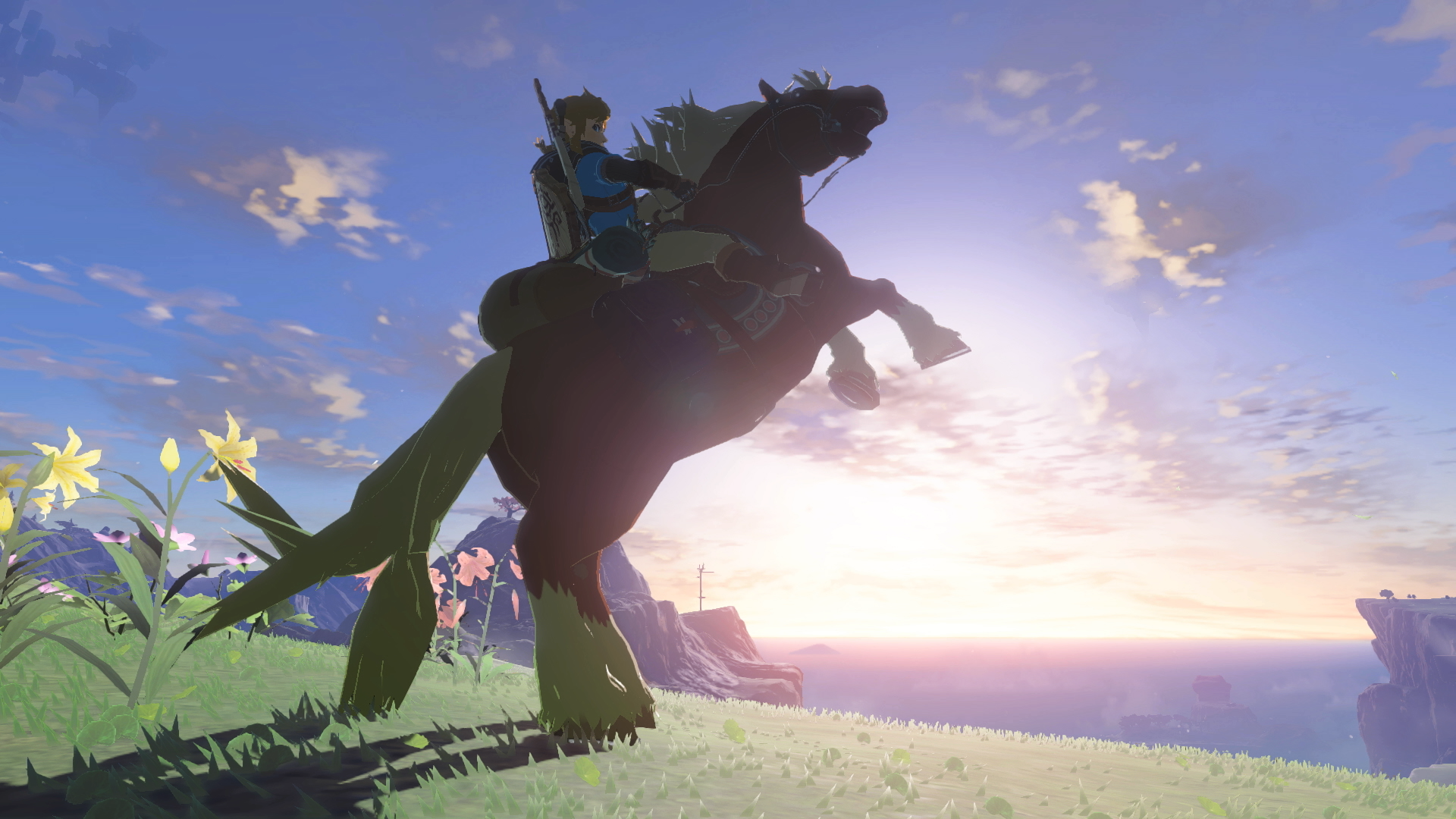
Between the surface, the Sky Islands, and the Depths, I spent 80 hours getting as lost in Tears of the Kingdom’s world as I possibly could and I loved every second of it. I was truly immersed as the pull to explore had me tight in its grip from the moment I first set foot on the Great Sky Island. I wanted to see what was over every hill, chat with every townsperson I came across, delve into the unknown, and soar through the sky. In fact, I was so taken with Hyrule that near the end of my playthrough, I struggled to resist the urge to let loose so that I could focus on the main quest and start writing this review. There’s still so much that I’ve yet to see and do, and I’m excited to go back and see what else is out there for me.
Overall
If I had to describe The Legend of Zelda: Tears of the Kingdom in one word, it’s limitless. It delivers adventure on a level that I rarely experience in a video game, with an incredible amount of depth and wonder that constantly had me in awe. It’s a game that tells you what its rules are and dares you to see how far you can push them, with the biggest barrier to experimentation being yourself. And it does all this while telling a compelling story that had me hyped one moment and devastated the next. Put simply, Tears of the Kingdom is a one-of-a-kind game and a spectacular achievement.
 TheComfySpot