- Developer: Square Enix
- Publisher: Square Enix
- Reviewed On: PlayStation 5
- Available On: PlayStation 5
Going into Final Fantasy VII Rebirth, I was equal parts excited and nervous. Its predecessor, Final Fantasy VII Remake, set a high bar after it managed to blow me away and become one of my favorite entries in the franchise. After spending just shy of 80 hours with Final Fantasy VII Rebirth, I feel confident in saying that once again my expectations have been surpassed in ways I never would’ve imagined. There are some bumps along the way, but they don’t keep Rebirth from being one of the best Final Fantasy games I’ve played.
Continuing from where Remake and its DLC left off, Rebirth sees Cloud and friends searching across the globe for Sephiroth in a race to stop him from enacting his malevolent plan. Covering the party’s time in Kalm through the events at the Forgotten City, this worldwide chase is a solid narrative baseline to work with, but it means that the story is essentially spinning its wheels for the better part of its 14 chapters. For more than half of the game, the party shuffles from location to location as they follow robed figures connected to Sephiroth and cross paths with Shinra along the way. To be fair, this middle segment of the Final Fantasy VII story played out the same way in the original game too, but the narrative’s lack of any forward momentum is more apparent when that segment becomes the entirety of a single game.
While this might be a problem for some, it wasn’t much of one for me, partly because Rebirth is more of a character-driven game than a plot-driven one. Just like in the last entry, Final Fantasy VII Rebirth elevates the cast by highlighting their personalities and bringing out what makes each of them so great. Take Yuffie for example, a character whose enthusiasm and youthful bravado are so infectiously charming that it’s impossible to dislike her. At the same time, Rebirth also digs into the cast and pulls back new layers of depth from each of them. An early side quest that has you escorting a dog to a woman’s son ends up being a beautifully cathartic moment for Barret to explore his fears about Marlene growing up and what that means for him as her father.
More than anything, Rebirth emphasizes the bonds that the party has with one another. Whether it’s the burgeoning respect that Barrett and Red XIII have for each other, the reacquainting that Cloud and Tifa experience after the years they’ve spent apart, or the lighthearted relationship that Aerith, Yuffie, and Tifa have with each other, the bond shared between the party members is constantly growing in fascinating ways. And while Cid and Vincent don’t formally join the party this time around and only have a small amount of screen time, the connection they form with the main crew leaves a strong impression that has me eager to see how the group continues to evolve and connect in the next game.
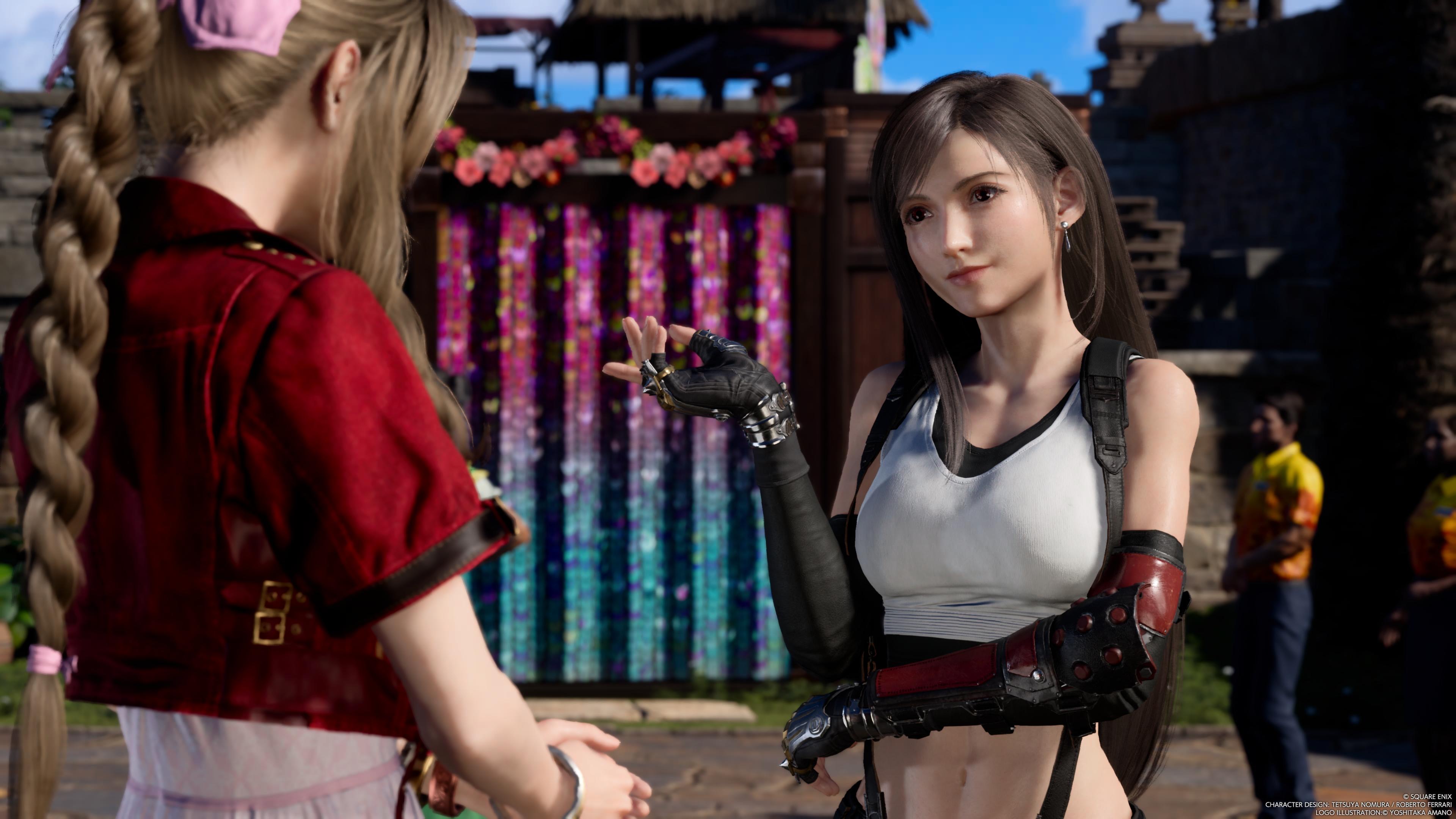
Of all the bonds in Final Fantasy VII Rebirth, the one that I feel is the heart and soul of the story is the one between Aerith and Tifa. We got a glimpse at the beginnings of their close-knit friendship in Remake, and Rebirth fully dives into it, portraying one of my favorite female friendships in a game. They’re each other’s confidants as they look to one another for support, and hype each other up in the many fun scenarios the party experiences. Rebirth truly does an amazing job showing that they’re best friends in every way, making for an immensely heartwarming relationship that wholeheartedly embodies the spirit of the game.
This emphasis on bonds results in some of the strongest character work in Rebirth and made me fall in love with the cast. It heavily reminded me of how connected the main cast was in games like Final Fantasy X, Final Fantasy XV, and Persona 5 Royal. Part of what made those games stand out to me was the way the character relationships shined, and the same can be said for Cloud and the rest of the team now.
One thing about the original Final Fantasy VII is that it was always a relatively goofy game, and Rebirth doesn’t shy away from that legacy. It’s infused with such an overwhelming amount of fun that there’s never a dull moment concerning the narrative, the gameplay, or the characters. Classic moments such as the Junon parade have had their silliness dialed up a notch, while others like the boat ride to Costa Del Sol are home to incredible reimaginings.
This lightheartedness also trickles down to the characters and their interactions with others. One moment in particular that I enjoyed was Red XIII getting snippy because we used Chocobos for tracking instead of relying on him. Another that got a good laugh out of me came from Aerith playfully questioning her intelligence in response to Barrett berating people who believe Shinra’s propaganda. Dio’s constant flexing throughout conversations is absolutely ridiculous, but it’s absurd in just the right way that I couldn’t help but find it funny. I can’t stress enough how much Rebirth’s ability to just have fun with all of the characters not only makes for an experience that’s especially refreshing after last year’s more serious Final Fantasy XVI, but also went a long way toward making me fall in love with them.
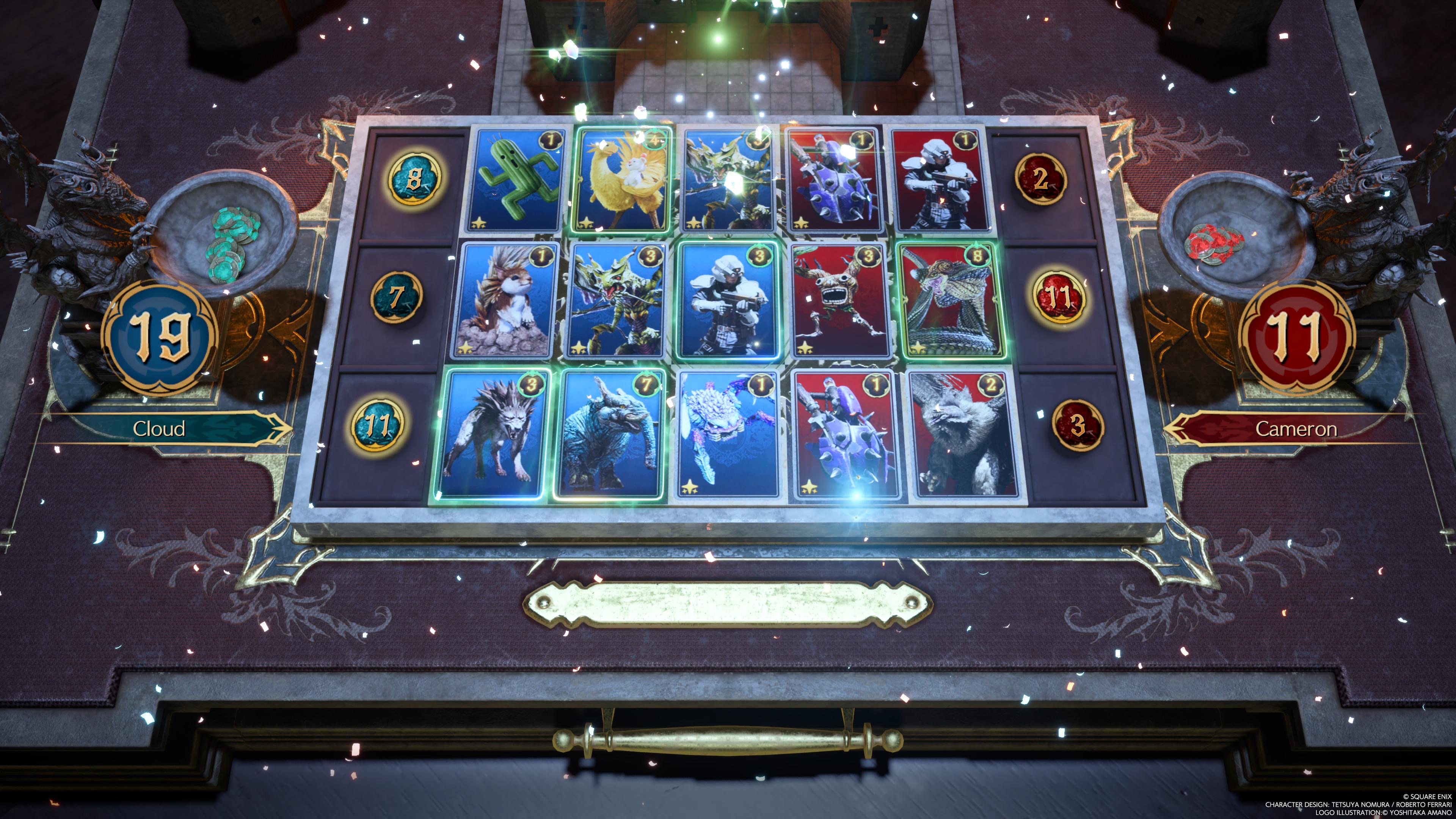
Rebirth also contains a lot of mini-games as part of its main story and side quests. They can range from the mundanity of picking mushrooms to the ridiculousness of playing a last-man-standing game as a frog. The most prevalent mini-game is Queen’s Blood, a card game that nearly everyone in the world plays. It’s easy to pick up but difficult to master, and although I’m not much of a card game person, I actually enjoyed it and played against everyone that I could for the first half of the game until I couldn’t keep up with the more challenging players. I can understand why some might feel like the mini-games get to be too much when they happen so frequently, and while there are a few duds, I enjoyed these easygoing breaks from the standard gameplay and the main narrative.
There’s a lot here that’s silly, and aside from being self-aware, what makes it all work is the amount of heart that every instance of it has. It adds to the charm of Final Fantasy VII Rebirth and consistently had me smiling as my love for this world and its characters grew the more that I played. As I progressed through each chapter, I had so much fun with the story and characters that it took me dozens of hours to realize that the main narrative had barely advanced. Once things did get more serious as the narrative picked up momentum in the back half of the story, the love that I had built up for all the characters made the events that followed much more impactful.
While Rebirth’s tone and stellar character work are enough to make up for some of the narrative’s shortcomings, they can’t make up for all of them. Once again, the decision to split the Final Fantasy VII story across three separate full-sized games results in some sections feeling drawn out for the sake of making the game a few hours longer. It doesn’t happen often, but when it does it’s undeniable. There’s also the subject of Crisis Core protagonist Zack and the storyline surrounding him. Without getting into specifics, while it’s nice to see Zack alive and interacting with characters he never got a chance to before, this side of the story is largely underwhelming.
Lastly, there’s the ending, which I’m honestly pretty mixed on. Even more than in Remake, it presents a litany of questions about what’s happened and what’s to come. While I do enjoy some of the mystery here, I feel like the overly cryptic execution does more harm than good by taking away some of the impact of the events that wrap up this chapter in the story.
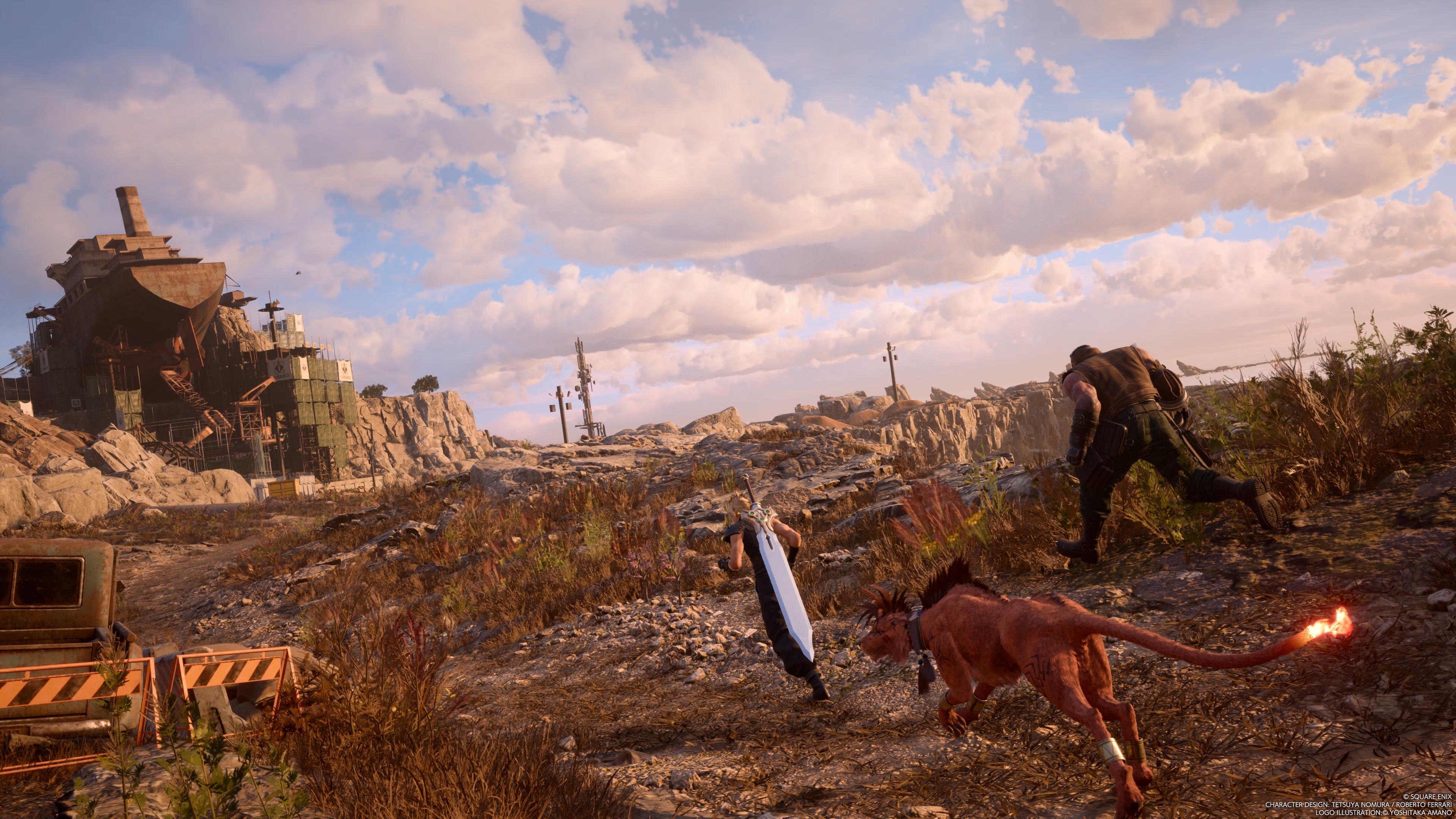
One of the things I was most looking forward to from Final Fantasy VII Rebirth was being able to explore the larger world outside the cold, oppressive confines of Midgar, and it doesn’t disappoint. Each region and town has been lovingly brought to life through a combination of visuals and music that always had me in awe. The town of Kalm is a bustling hub with a theme song that makes it feel as tranquil as its namesake, while the vast Grasslands outside of it are vibrant and picturesque, serving as a reminder of the world that the party’s fighting to save. Costa Del Sol was a highlight in the original game, and that remains the case here thanks to how effectively it captures the feeling of being at a beachside resort, with crowds of people and a laundry list of activities to participate in.
And I can’t talk about great locations without mentioning the iconic Gold Saucer. It’s everything I imagined a modern-day version of it would be and it turned me into a kid at Disney World as I excitedly ran from one section of the expansive park to the next. Every location in the world is honestly a sight to behold. That said, there are some moments when distant objects have noticeably worse textures than those right next to them, causing them to stick out like a sore thumb.
The towns are also where you’ll find Rebirth’s narrative-focused side quests and they’re well worth the time and effort. They continue to prioritize the characters, with each one revolving around Cloud and select members of the party, which was something that I loved since it continued to build up the bonds that you share with everyone. The stories they tell are all pretty great as they provide a relatable window into the greater world and the people that inhabit it, while also maintaining the same light and fun tone as the rest of the game. Some even continue plot threads from the main narrative, which gives them an extra bit of weight and importance.
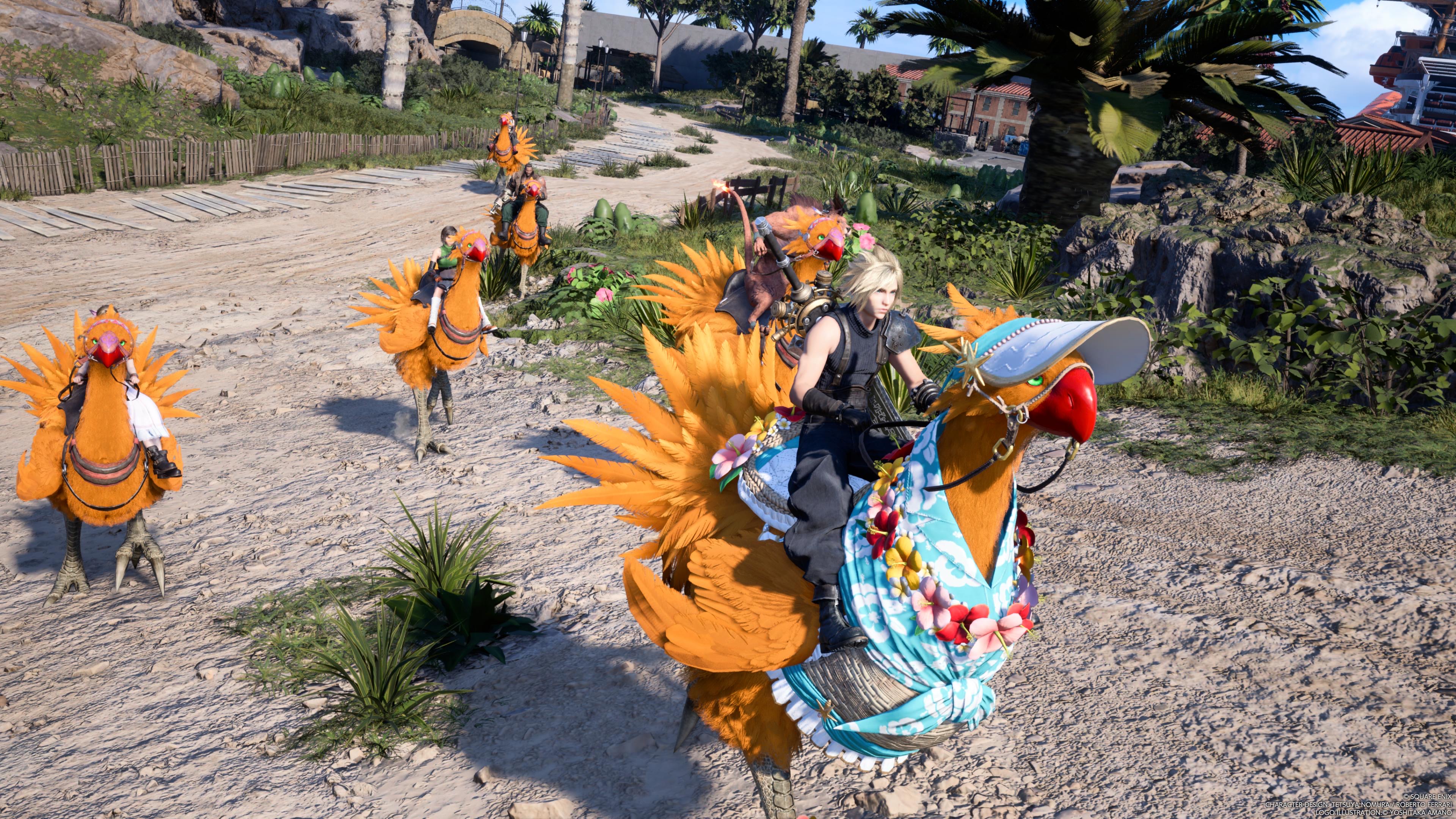
When it comes to the activities in the open world, Final Fantasy VII Rebirth doesn’t diverge much from what’s standard in modern-day open worlds and implements many ideas from others in the field, but that didn’t make these tasks any less fun to me. Some are pretty by the books, such as taking out rare fiends and revealing new things on the map by climbing towers, but others like playing with Moogles and gathering rare relics add some of Rebirth’s trademark lighthearted fun to spice things up. And although you can just go to a tower to find nearby activities and points of interest, just exploring naturally will bring you to them as well. Taking a page from Ghost of Tsushima, birds will lead you to nearby lifesprings and baby Chocobos will guide you to rest stops that you can restore and activate for fast travel. They may not be original touches, but they make the world feel more lived in and natural than it would without them.
What also helps keep exploration fun is the fact that each region feels distinct and has a different gimmick that’s used in it. Traversing the arid desert in the Corel region is made much easier and more enjoyable with the help of the monster-truck-sized buggy. Seeing all that the Junon region has to offer requires the use of its wall-climbing Chocobo to reach its highest peaks.
Not every area is made equal though. The vibes in the Gongaga region are immaculate thanks to its beautiful lush jungle and the captivating music that makes it feel like you’re on a wildlife expedition, but exploring its dense environment was a confusing chore that I quickly grew tired of. Cosmo Canyon also has some of the best vibes in Rebirth, largely in part from its Old West-inspired take on the Final Fantasy VII theme song, but suffers from a similar traversal issue as Gongaga, though it’s a bit easier to navigate since you can clearly see the surrounding space.
Overall, Rebirth’s world is massive and filled with plenty to see and do. Even though some areas were more troublesome than others and visual inconsistencies cropped up every so often, these issues didn’t detract too much from my time exploring the world. I still had a blast absorbing every region as much as possible before continuing the story and moving on to the next one.
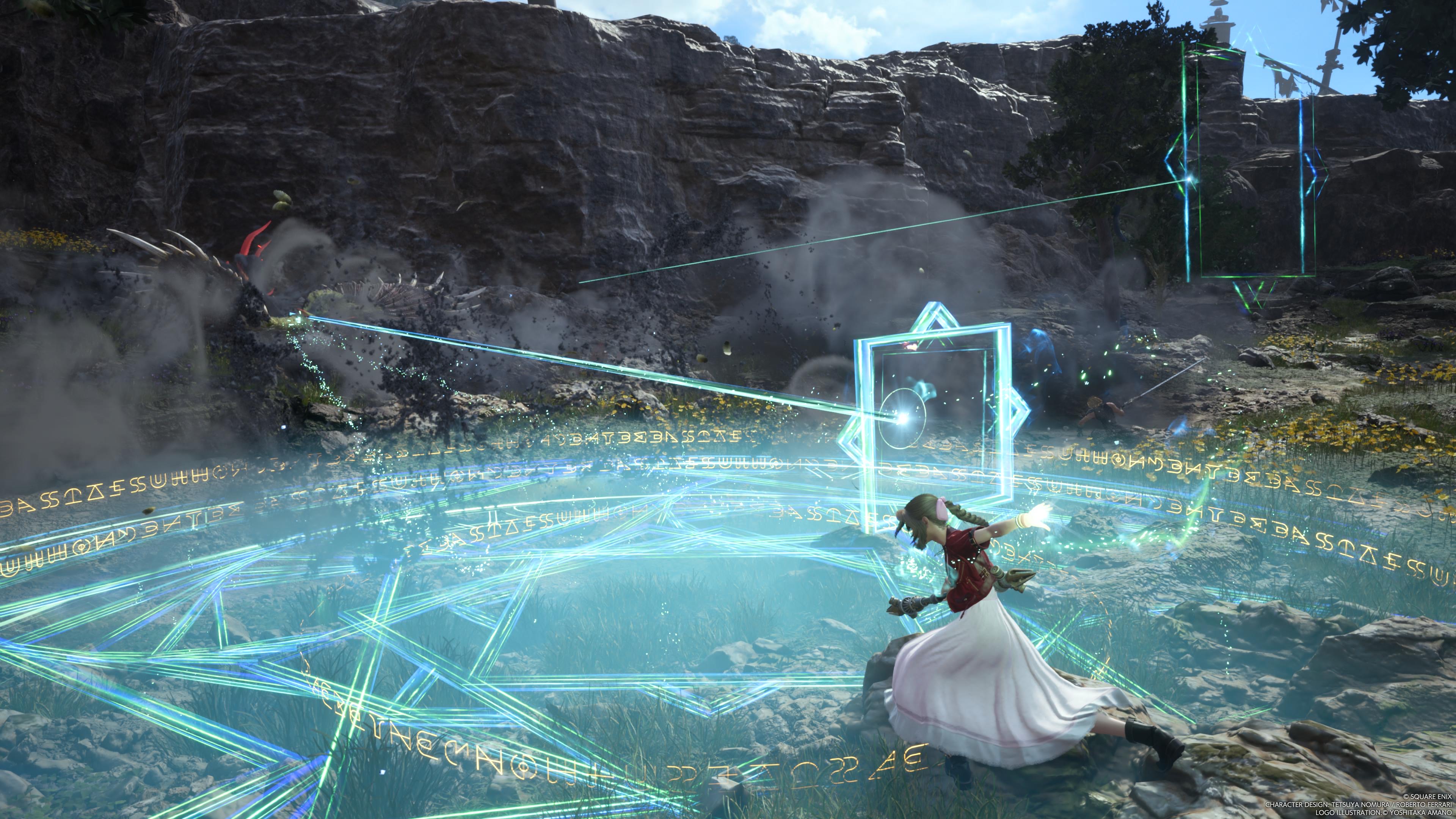
Combat was one of the key highlights of the first entry in this remake trilogy, and Final Fantasy VII Rebirth improves upon it through a series of smart and welcome additions that make combat more dynamic and exciting. Changes such as Cloud’s blade firing off ranged blasts when you attack right after a dodge, or Aerith’s ability to teleport between different wards that she places on the field are minor in the grand scheme of things, but they completely changed the way I approached combat when playing as them. And I’d be remiss if I didn’t mention how much I appreciate the way that air combat is now a viable option for Cloud and Tifa, making it much easier to take on flying enemies.
One of the more major additions is the inclusion of new elemental abilities to unlock for everyone that can be used without MP. While these new moves are weaker than using the actual Materia spells, the fact that everyone always has constant access to each element provides more flexibility when choosing Materia for your party members, which I greatly appreciated.
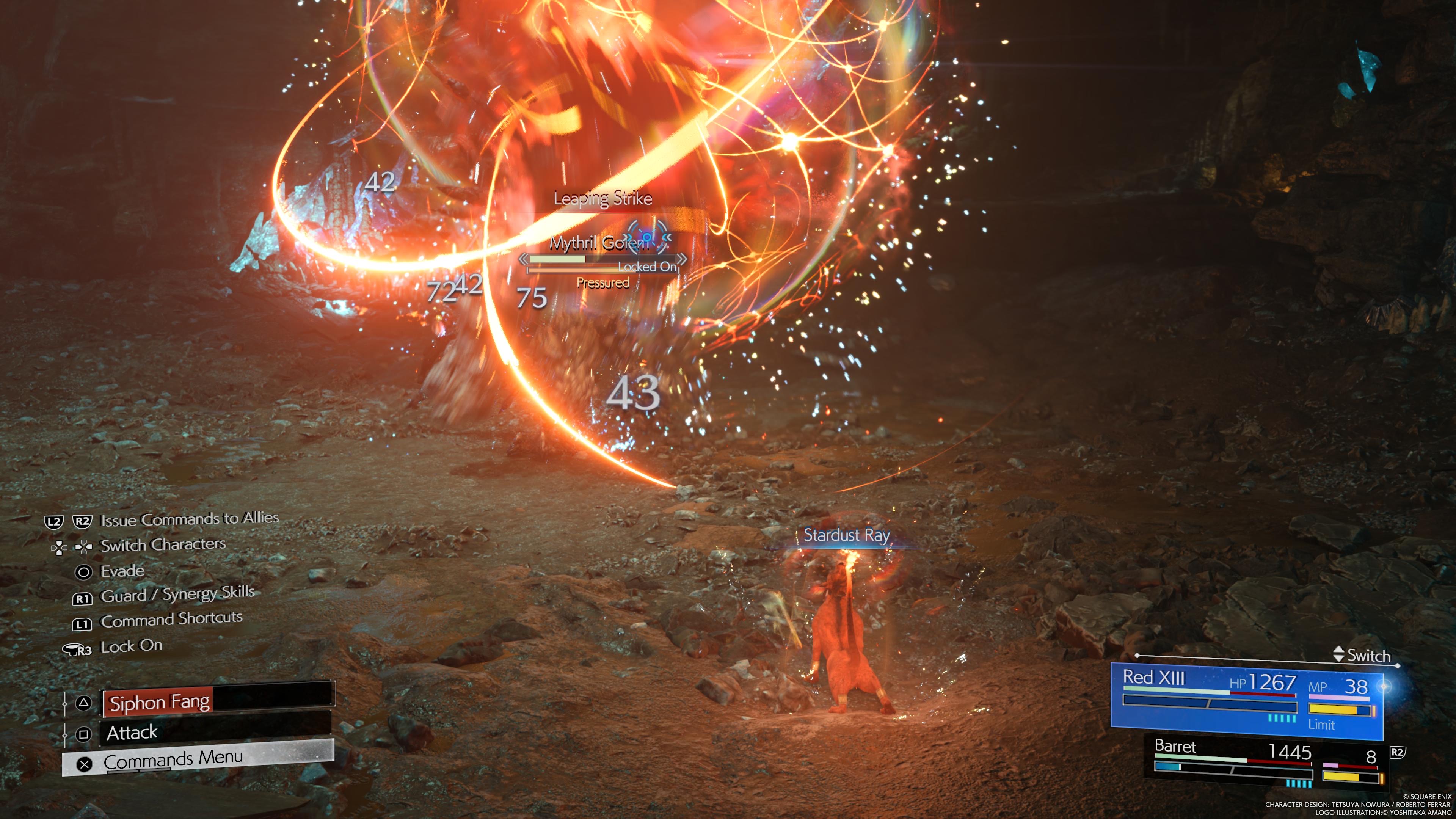
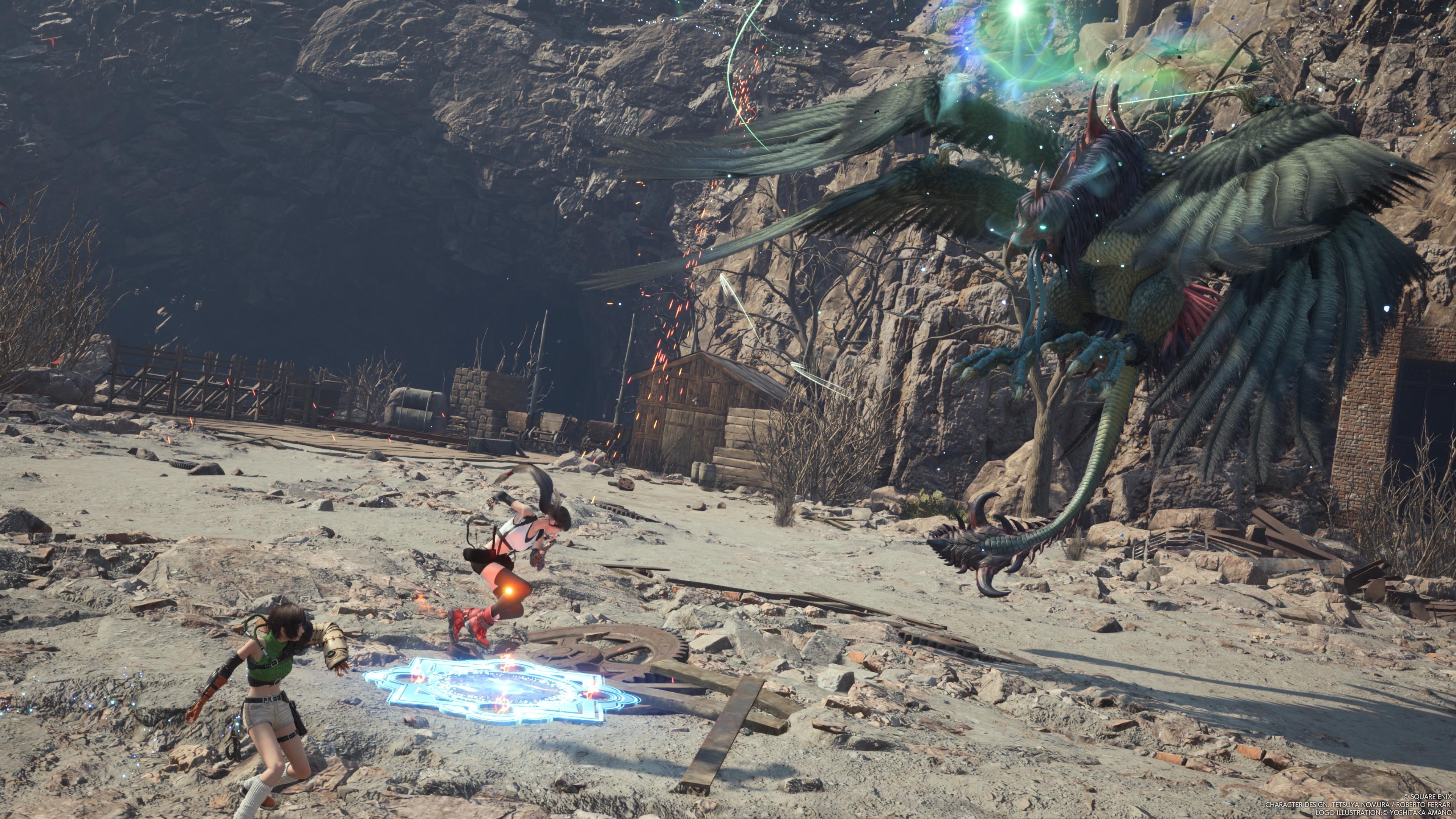
Of course, the biggest additions to combat are the newest members of the party. Yuffie, Red XIII, and Cait Sith each bring something different to the table that makes them stand out from the rest and plenty of fun to play as. I was already a fan of Yuffie’s playstyle after going through her Episode Intermission DLC in Remake, and she continues to shine in Rebirth. Her speed and expertise in both ranged and close-quarters combat, combined with her elemental ninjutsu attacks, made her a versatile powerhouse that I couldn’t get enough of. Meanwhile, Red XIII is speedy and can deal some healthy damage with his basic attacks, but he’s more of a character that relies on absorbing damage and dishing it back out with counters. I didn’t rely on countering too much, but I still had a good time using him to deliver a flurry of quick attacks until I was able to use stronger ones like the explosive Stardust Ray.
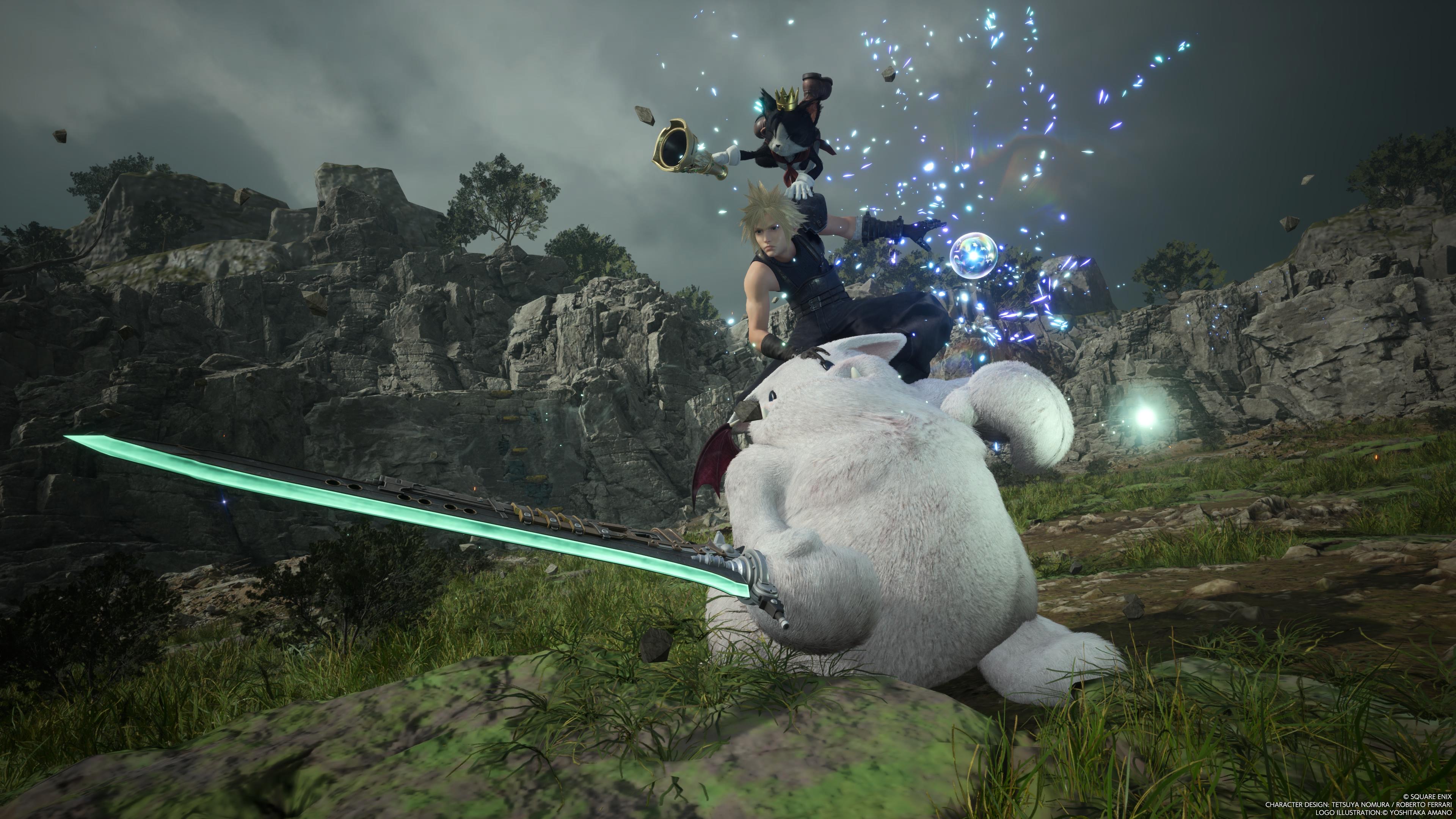
And then there’s Cait Sith, one of the party’s more unique members to use in combat. Unlike most of the team who are about pure aggression, Cait Sith’s playstyle is somewhat similar to Aerith’s in that it largely revolves around getting in hits where he can from a distance to build up his ATB gauge. Unlike our wholesome flower girl who then has a litany of spells to choose from, Cait Sith can then either summon his Moogle for extra assistance or bestow perks upon the party with his lucky dice. Add on the fact that he’s a fairly weak character with little in the way of attack options, and you’re met with a bit of a learning curve to figuring out how to best use him. He may not be for everyone, but once I found my rhythm using Cait Sith in more of a support role, I had quite a bit of fun playing as him.
With a full party of seven characters, Final Fantasy VII Rebirth expands the party system by letting you create different teams of three that you can switch between on the fly while exploring the world. Anyone not on your frontline is still visible in the field and will even attack from a distance if they can, which is a fun touch that makes backline party members still feel present in combat. Although Cloud is required to be in each team you make for your initial playthrough, I loved the freedom and possibilities the party system opened up for combat since I structured each party around everyone’s strengths and weaknesses.
One team I made consisted of Cloud, Barret, and Cait Sith, with Barret assisting Cloud with dealing damage and healing, in addition to providing support with Cait Sith away from the heat of the battle. Another team saw me tag in Aerith and Red XIII, with Aerith firing off magic from the safety of her wards and healing the boys as they got up close and personal in fights. One of my favorite teams consisted of Cloud, Yuffie, and Tifa since it focused on speed and power, allowing me to dish out fast and furious attacks. My party composition was something I was frequently playing around with to try new setups and see if I found any new favorites.
Adding another layer of importance to party composition is the new synergy system. Rebirth introduces new moves that different pairs of characters can perform with each other called synergy skills and synergy abilities. Synergy skills are quick moves that can be performed at will and boost the ATB gauges of the characters involved, providing them with faster access to their more powerful moves. Using an ATB charge will then partially fill their separate synergy gauge. Filling the synergy gauge enough for different characters will allow you to then perform their stronger synergy abilities. These moves are like mini-Limits as they can deal a healthy amount of damage to enemies, and they also have the added benefit of giving the characters who performed them a special boost such as extending how long an enemy’s staggered or raising the level of their actual Limits.
The synergy system adds a fun layer of complexity to Rebirth’s combat that took me a bit of time to adjust to and start integrating into fights, but once I understood how it fit into the battle system, combat was elevated to a whole other level. Seamlessly blending slick synergy skills with my regular combos and abilities as I bounced between characters and built toward their synergy abilities never got old. This was especially true when going up against stronger enemies or proper bosses where they could make all the difference in how the fight turned out. Using a synergy ability that temporarily gave my characters unlimited MP was a boon that regularly allowed me to massively heal my party or deal heavy elemental damage to exploit an enemy’s weakness.
Another reason I greatly enjoyed the synergy system is because it feeds into the development of the party as they go about their journey. Using these synergy moves grows Cloud’s relationship with each party member, which in turn made the group progressively feel more and more like a family and caused me to become more attached to everyone. They provide a real sense of camaraderie that I haven’t felt from the series since I played Final Fantasy XV eight years ago. On top of that, it’s also just plain cool to see everyone team up and perform these flashy, over-the-top attacks.
When it comes to upgrading your weapons and characters, Rebirth makes some changes that streamline certain elements and greatly expand others. Weapons now each have one set of skills that offer a range of benefits based on the character, and the higher your overall weapon level, the more skills you’re able to equip. Cait Sith, for example, will have some skills that revolve around his Moogle’s capability in combat, whereas Aerith will have skills that focus on increasing elemental damage. The system that Remake had wasn’t bad, but I liked how much more simplified this new system is.
As for character progression, Final Fantasy VII Rebirth introduces a new ability tree for everyone that allows you to build up their stats and unlock new moves for them. This tree expands throughout the journey as your party level increases, giving extra incentive to complete as many side objectives as possible. While there is a bit of an order to which things need to be unlocked on these ability trees, I do like how it provides enough flexibility to let you unlock the ones that matter most to you at any given point.
I’ve made a few mentions of the music throughout this review, but I do want to quickly give it a bit more attention because it’s simply incredible. Tracks such as the Junon field music had me ready to join a pirate crew, whereas the relaxing rendition of the Final Fantasy VII theme song that plays on the boat to Costa Del Sol made me want to kick back with a cold drink while watching the sunset. The battle music also provided a reliable shot of adrenaline that amplified every fight I was in, especially when it was a combat version of the theme song. There’s a wide range of tracks here and every single one of them is a banger. Trust me when I say that your favorite song may end up being one that you least expect.
Overall
Whenever I start a new game, sometimes I’ll have a moment where things click and I just know that it’s going to be something special. From its very first chapter, I knew that Final Fantasy VII Rebirth was going to be one of those special games that was everything I wanted it to be and so much more. While there are some issues with the main narrative and the world design, they ultimately are overshadowed by the many ways in which Rebirth excels at delivering a best-in-class experience. The characters are excellent, the world is amazing, and the combat is better than ever. And it’s all backed up by a sense of fun that the series hasn’t had in a long time. Final Fantasy VII Rebirth is a superb video game, and it just might be my new favorite game in the franchise.
 TheComfySpot