Kingdom Hearts is a special series to me. Not only has it played a key role in molding me into the person I am today, but it’s also been a constant source of comfort for me throughout my life. With that in mind, I decided to go back to six key games from the franchise, some of which I haven’t played in a long time, in a series I call Revisiting Kingdom Hearts to see what I think of them in the year 2024. Have my feelings changed about each game over the years? Am I able to take away anything new from them that I didn’t before? How does any one game compare to the rest of the series? These are the kinds of questions I’ll be asking myself as I work my way through the franchise. In part four of this series, I’ll be talking about Birth By Sleep, and my complicated feelings on this pivotal game in the franchise.
When I first played Birth By Sleep on the PSP shortly after it came out, I was head over heels for it and felt like it improved on Kingdom Hearts II in every way. But in the years since it’s come to console, I’ve played the remastered version multiple times and my love for it has waned quite a bit. It’s an important game as it brought great ideas to the table that creatively built off the groundwork Kingdom Hearts II laid for the series, and these ideas became the backbone of its future. At the same time, some of these ideas are negated by certain aspects that aren’t so great. The result is a Kingdom Hearts game that sees the series taking great strides forward and frustrating steps backward.
Where Birth By Sleep excels the most is in its story, as it marches headfirst down the new path the series created for itself by doubling down on telling a more mature, nuanced story with multiple layers of complexity. We get critical additions to the lore with an excellent cast of new characters, the mysterious χ-Blade, and the fabled Keyblade War. We learn of the Wayfinder Trio’s connection to Sora, Kairi, and Riku, and how the future of the Destiny Trio was put in motion by their childhood interactions with Ventus, Terra, and Aqua. Xehanort is established as the main villain of the series and we discover how he came to be an apprentice to Ansem the Wise. I love every single one of these narrative choices because although they do complicate the story of the Dark Seeker saga, they don’t overcomplicate it. Rather, they make the series richer and more fascinating, and the secret ending, Blank Points, masterfully connects them to the future of the series, beginning to set the stage for Kingdom Hearts III.
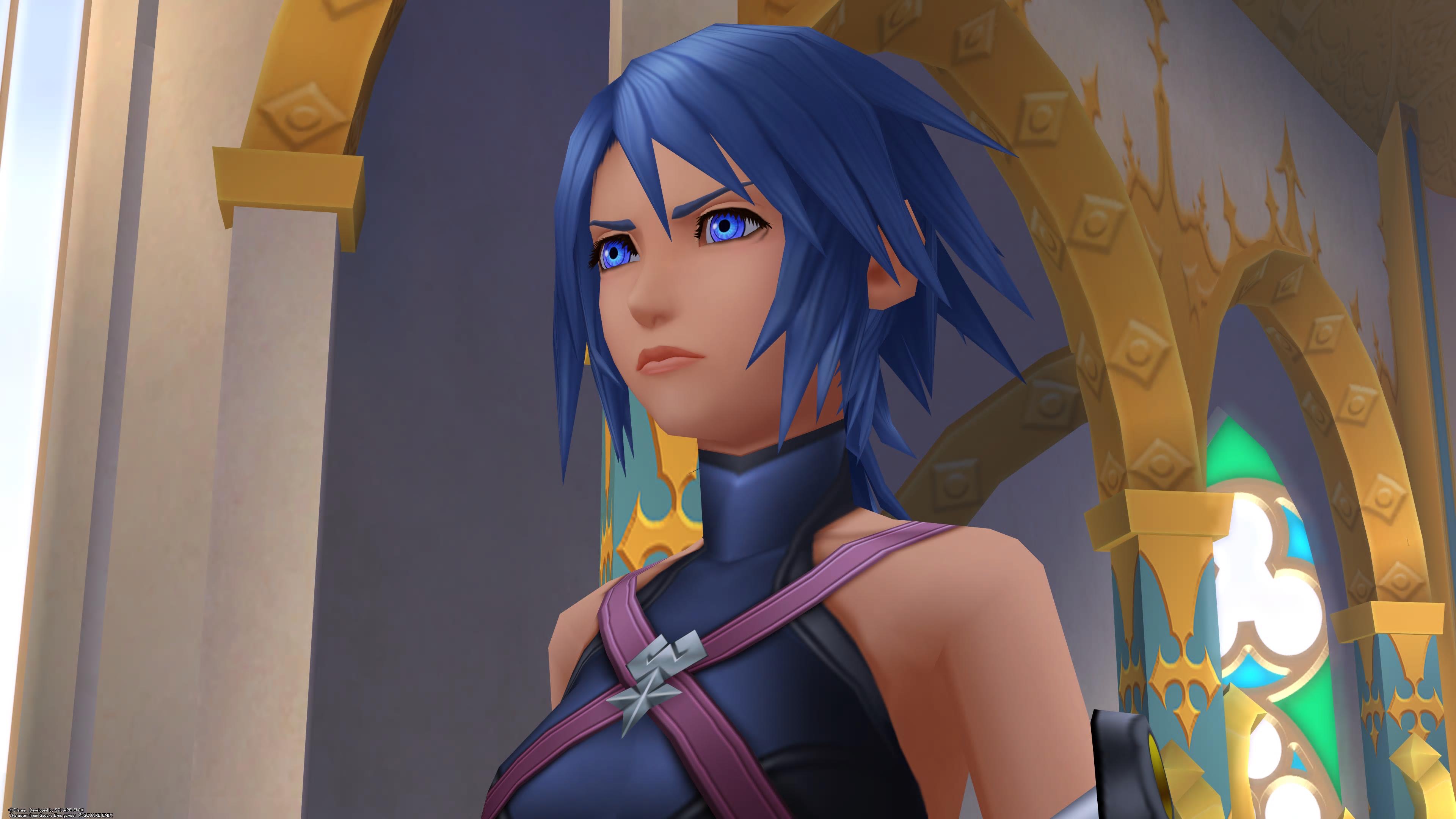
The elevated nuance and complexity are also evident in Birth By Sleep’s storytelling, as it’s not done in a straightforward manner. Ventus, Terra, and Aqua each have their own route to go through that reveals part of the bigger picture, with the whole story being revealed once they’re all completed. It’s a massive departure from the norm, but I really enjoy this as it makes the act of experiencing the story much more engaging due to the way it drip-feeds new information throughout each route, subsequently raising a litany of questions.
What are the other characters experiencing that I’m missing out on? How are they handling their journey and what’s caused any changes that I see in them when we cross paths? I love how the overarching plot is intricately structured so that each story is gratifying on its own while maintaining a level of mystique and intrigue for the others. It results in an extremely satisfying conclusion when all the pieces are put together.
Birth By Sleep’s story is more mature than many others in the series, and the same can be said about its tone. There are plenty of light elements in the narrative as is expected in a Kingdom Hearts game, but where other entries feel optimistic for the majority of their runtime, there’s a certain heaviness that’s prevalent throughout Birth By Sleep that I relish. This stems from Master Xehanort who proves to be a fantastic antagonist. Where the Wayfinder Trio and the Disney worlds provide the narrative with the light optimism that’s expected from the series, Xehanort’s schemes counter it with a darkness that infuses the story with an underlying sense of dread. This culminates in the climactic battle with Xehanort and Vanitas in the Keyblade Graveyard. The scale of the fight makes it one of the most epic moments in the series, and its high stakes still have me on edge when I play through it today.
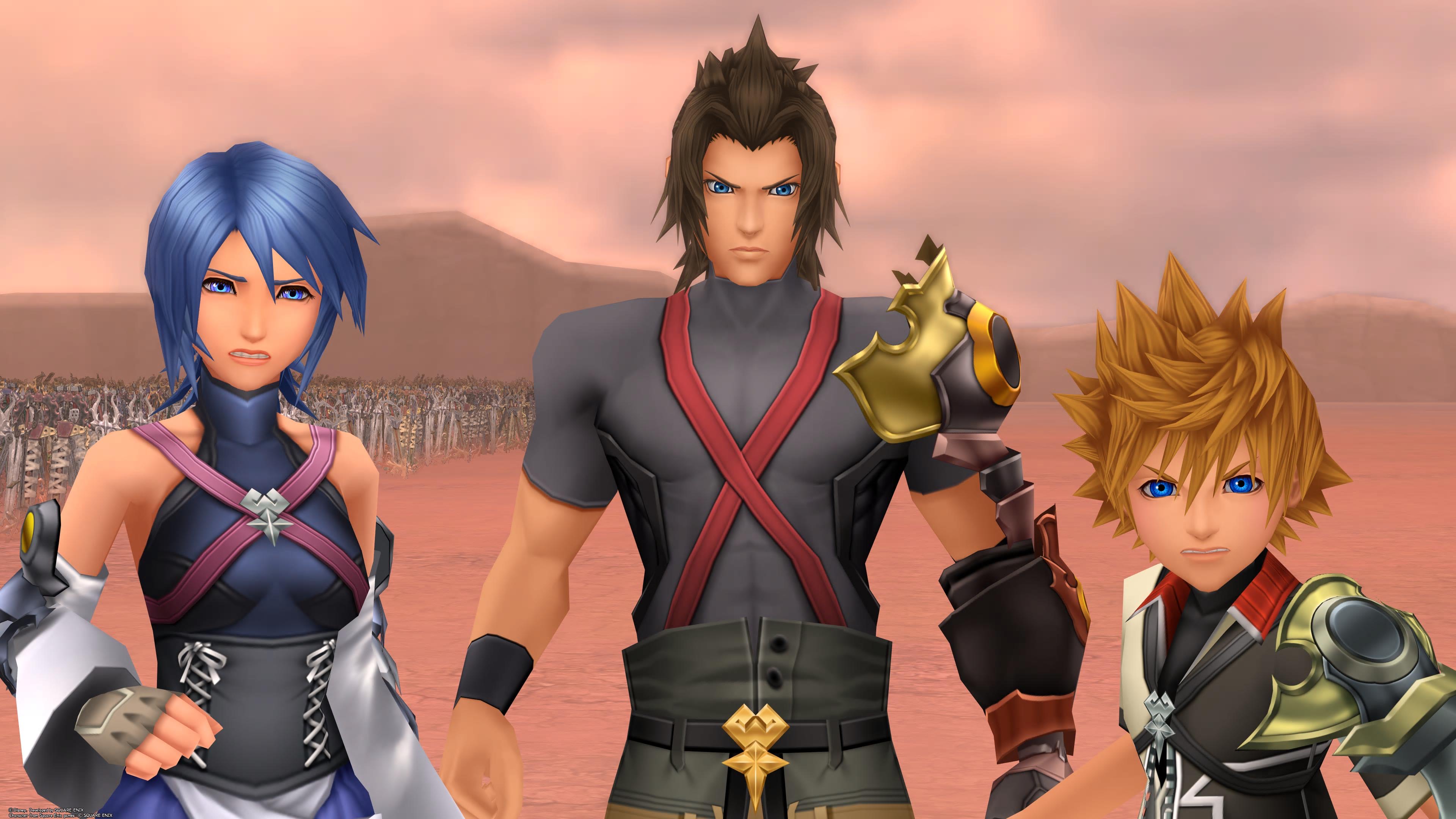
The one area where the increased maturity and complexity of Birth By Sleep’s story can be most felt is in its characters, specifically Ventus, Terra, Aqua, and Master Xehanort. While the main overarching story revolves around finding Terra and Master Xehanort, with a hint of Vanitas sprinkled in too, the story’s real focus is on the development of the Wayfinder Trio as a group and as individuals. They’re stellar characters and their wholesome introduction works wonders by showing that although they’re best friends, they’re also like a family, with Ven filling the role of the younger sibling, and Terra and Aqua being the older siblings. This makes for a relationship dynamic that’s distinct from the ones the Destiny Trio and the Sea Salt Trio have, and the narrative pulls on this to great effect, as it challenges their bond and results in their individual growth.
Terra’s desire to protect his friends, as well as his battle with his inner darkness, causes him to push Ventus and Aqua away and face the world alone. Through his journeys, he starts to realize that darkness isn’t his only path forward and tries to shun it, as he looks for the light in his friendship with Ven and Aqua. Ventus’ love and admiration of Terra and Aqua is a driving motivator for him, but it’s also a key weak point as the way they shun him out of concern for his safety makes him feel alone. As he travels to more worlds and discovers the truth about himself, his faith in the strength of their friendship is rekindled and he finds solace in their bond. Aqua’s love of her friends sees her trying to look out for them, but becoming more distant from them in the process as they walk their own paths. Even still, her confidence in them and their bond persists and helps give her the strength to save them both and then stay alive in the Realm of Darkness.
As a quick aside, I do want to say that although Aqua has perhaps the least amount of character growth out of the trio in Birth By Sleep, she’s by far my favorite of the group. Her strength of heart and ironclad will are admirable, her compassionate soul is heartwarming, and her devotion to her friends is inspiring. In a series that doesn’t have the strongest female representation, Aqua is a welcome breath of fresh air and an icon in her own right.
The heavy emphasis that Birth By Sleep’s narrative places on the friendship between Ventus, Terra, and Aqua is one of its strongest aspects. When combined with the split narrative structure, the story is able to flourish in a way that other games in the series aren’t. We go on their separate journeys, see their different perspectives, and share their dreams, making the level of emotional investment so much greater.

That’s where Xehanort enters the picture. Perfectly voiced by Leonard Nimoy, Birth By Sleep instantly cements Xehanort as the best villain in the series, partly because there’s a certain mystique to him that makes him fascinating. Whenever Xehanort speaks, I find myself hanging on every word he says because he’s that compelling of a character. He elegantly plants and waters the seeds of fear, doubt, and darkness in the Wayfinder trio, which constantly raises the question of whether or not Ven, Terra, and Aqua will be able to overcome their struggles and reconnect with each other before it’s too late, or if they’ll fall victim to his schemes.
Having played through Birth By Sleep multiple times and knowing how everything plays out, it’s still a major gut punch seeing how Xehanort manages to largely succeed in his plans by taking over Terra’s body, killing Eraqus, and scattering the Wayfinder trio. He may not have successfully summoned Kingdom Hearts, nor did he eliminate everyone, but he still had backup plans that would lead to his assumed future victory. Reaching this conclusion after working so hard to avoid it is nothing short of tragic, but it shows how dangerous Xehanort is and why he’s a force to be reckoned with.
Although it’s an unfortunate ending, it doesn’t define the story as a whole. As I was writing this piece, I was ready to say that at its core, Birth By Sleep is a story about three friends being torn apart by different means. While that’s true to an extent, I realized that’s not the full picture. Yes, tragedy is part of what defines Birth By Sleep’s story, but what I think defines it just as much, if not more, is hope.
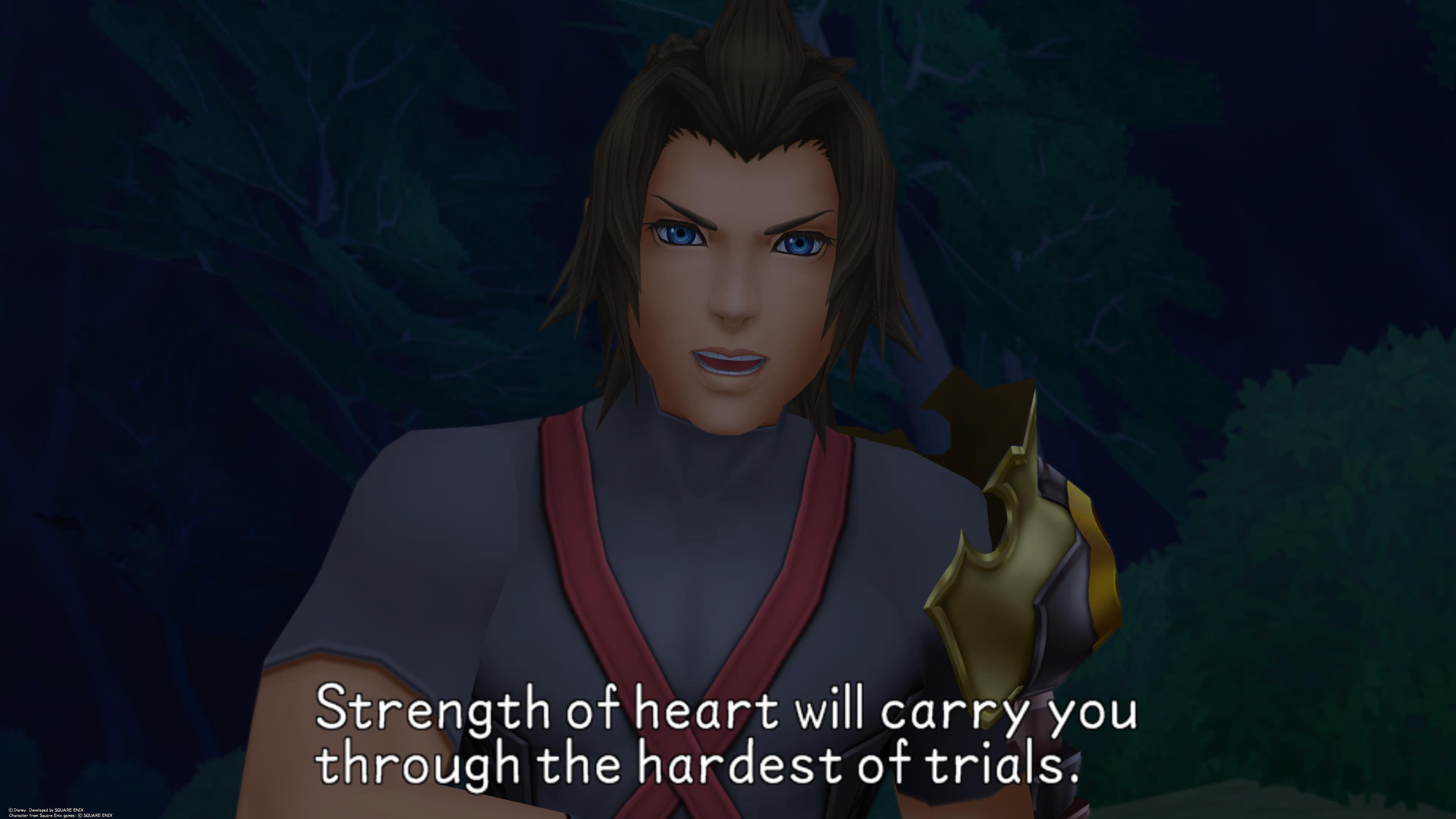
Hope is what keeps us going during hard times and Birth By Sleep wholeheartedly understands this. When friendships get messy and complicated, hope keeps us from giving up on them and maintains our confidence that they’ll be okay. When we feel like we failed ourselves and our loved ones, hope provides us with the motivation to keep trying to make them proud. It gives us the strength to do what we can to try and ensure a safe and prosperous future for our friends and family.
That’s the beauty of Birth By Sleep’s story; it’s a constant battle to keep hope alive. For every wave of darkness that washes over the characters, their bonds of friendship and memories of shared dreams fan the flames of hope to light the way and stamp out the darkness. And when the story comes to an end and it seems like all hope is lost for the Wayfinder Trio, it returns once again in the form of a boy whose heart has touched the lives of many.
I’ve always loved the story in Birth By Sleep and I feel like that love has only grown over the years because it does so much right and practically nothing wrong. It does a great job as a prequel by introducing fascinating new concepts and characters, while also recontextualizing old ones. We also get a heavier story and a narrative structure that focuses deeply on the characters at play and emphasizes the themes underlying it. I’ve gone back and forth on where I would rank its story in comparison to the rest of the series, but this playthrough has made me more confident than ever that the story in Birth By Sleep just might be the best of them all.
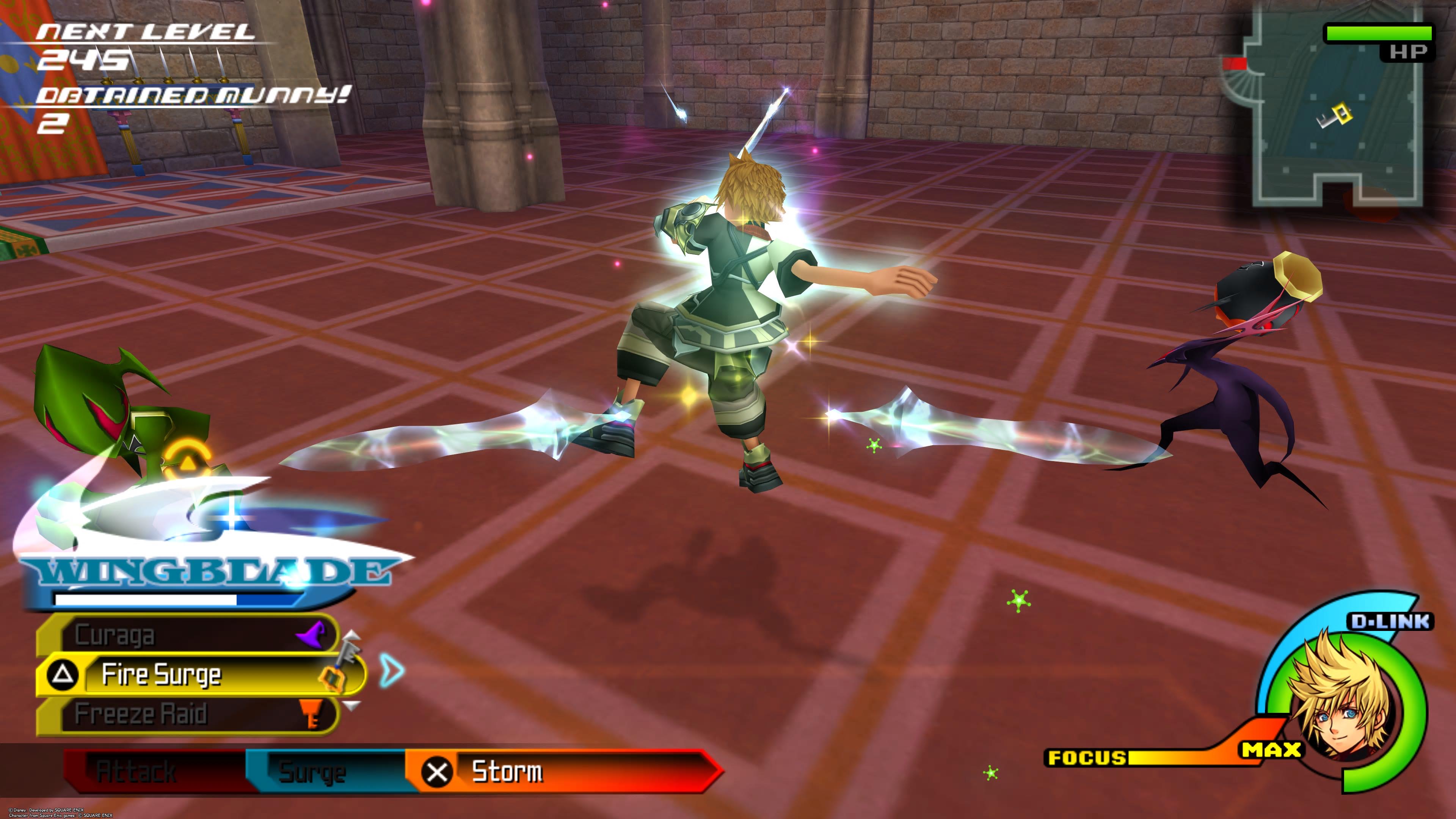
Now that we’ve talked about the best part of Birth By Sleep, it’s time to talk about the areas that I’m more mixed on, beginning with the combat. Birth By Sleep continues the series tradition of handheld games experimenting with new ideas while trying to retain the classic Kingdom Hearts combat experience, and on that front, it does perhaps the best job of any handheld game to this point. Thanks to a platform that’s a better fit and several creative ideas that continue to push the series down the action-focused, spectacle-heavy path Kingdom Hearts II set it on, Birth By Sleep doesn’t feel fundamentally different from its console brethren. Instead, it feels like a glimpse into where the series can go next.
For one, Ventus, Terra, and Aqua all control differently, lending each storyline an air of freshness as each character’s playstyle brings a bit of a different approach to fights. Ven arguably feels the most like Sora due to how agile he is, as well as his proficiency with both physical attacks and magic. Terra’s slower and heavier combat style emphasizes physical attacks, whereas Aqua’s also a fast attacker, but she leans more into magic with her moves. While I love the way Sora plays, it’s refreshing to play as characters who specialize in different disciplines and require alternate approaches to fights. That said, Terra is easily the worst to play as. Having to pause between hits in a combo to make sure they all land is annoying enough, but what’s worse is how horrifically bad Terra’s dodge is in comparison to Aqua’s and Ven’s due to its lack of invincibility frames and the way it lingers far too long when performed in the air.
The new Command Deck system is the foundation that Birth By Sleep’s combat is built on and it proves to be a smart way to translate Kingdom Hearts combat to a handheld platform while still encouraging planning and strategy. Unlike the card system from Chain of Memories, what makes the Command Deck so great to me is the fact that it doesn’t require you to bend over backward in battle, nor does it have any restrictive elements that make fighting enemies a pain. Instead, it simply feels like an alternative version of the combat we get in the numbered titles. Everyone has a basic three-hit combo and special finisher they can do, and the Command Deck expands on this by providing up to eight extra moves that you can perform in fights. They can range from casting magic and using items, to being able to use stronger and flashier physical attacks.
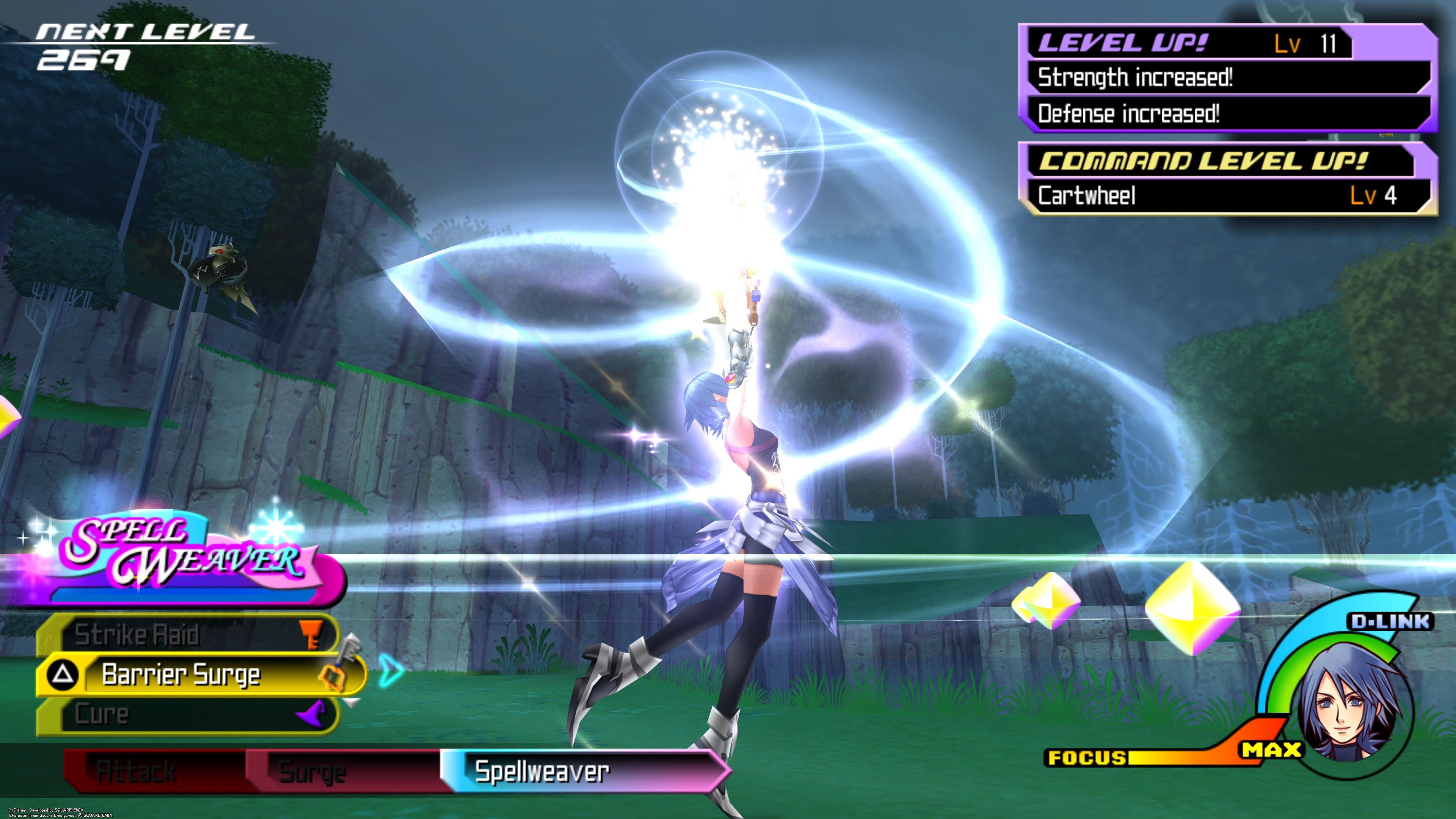
This leads to Command Styles, which are the poster child of combat in Birth By Sleep. Inspired by the Drive Forms from Kingdom Hearts II, Command Styles bring heaps of spectacle as they change the way each character fights for a period of time. Use mostly fire attacks and you’ll activate the Firestorm Command Style, which imbues your basic attacks with fire for as long as the style is active. Casting a variety of spells while playing as Aqua will activate her Spellweaver Command Style, causing her to adopt a more graceful and elegant form of combat that’s as mesmerizing to watch as it is fun to use. Similar to Drive Forms, the spectacle of Command Styles is a big part of why I like them so much, but I also appreciate how they’re a powerful reward for the choices you make in battle.
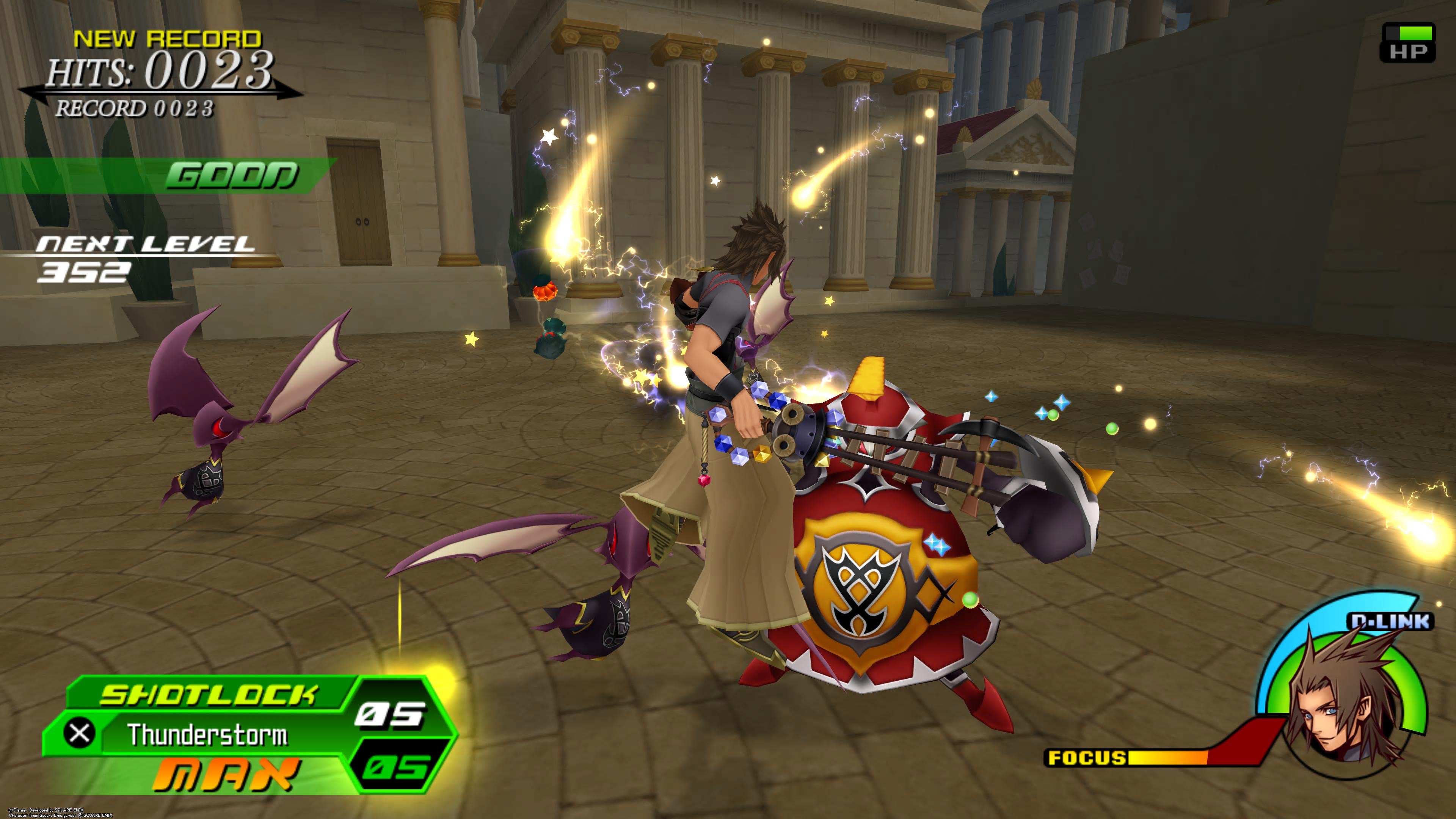
Just as strong and flashy are Shotlocks, another new mechanic that clears out groups of enemies with ease or deals heavy damage to a single target. They aren’t something I engage with too often, but I always enjoy seeing the different techniques that can be used. D-Links are Birth By Sleep’s equivalent of Summons, and while I use these even less than Shotlocks, I have grown to appreciate them as they’ve helped get me out of tight jams in the early stages of each character’s story.
The ideas introduced here are great ways to push the combat and gameplay for the series forward, but the execution behind many of them leaves much to be desired. Looking at Shotlocks, the fact that enemies still move in real-time while you’re waiting for them to fully charge up is a major annoyance, especially since the charge time varies for each Shotlock. Command Styles are incredibly cool to use, but it’s extremely annoying how you’re instantly forced into them whenever the Command bar has filled. On top of this forced activation interrupting combos and actions, it’s also just easier and faster sometimes to eliminate enemies when you aren’t using a Command Style.
One of my other major annoyances is that some of the finishers for Command Styles and D-Links last quite a while and can’t be canceled once started. The protracted finishers for the Rhythm Mixer Command Style and Mickey’s D-link are prime examples of this, even if they’re two of the more creative and unique ones. What makes this extra annoying is the fact that once available, the finishers are the only normal attacks you can perform unless you wait for the Command Style to end on its own, which leads to wasted time or a wasted move on weak enemies.
Each of these issues comes as a result of Birth By Sleep doubling down on the spectacle that Kingdom Hearts II brought to combat at the expense of it feeling as good as its inspiration, and these aren’t the only ones. The floatiness of combat in Birth By Sleep has been well-documented since it first reared its head in 2010, and the amount of time you linger in the air after jumps and attacks has only felt worse over the years. You’re always doing attacks that are all about being flashy and looking cool, but the combat lacks the control that would make these moves feel good to perform.
All of these issues are bad, but the worst of Birth By Sleep’s new gameplay ideas is undeniably the Command Melding system. To unlock new Commands, you have to create them by combining two fully leveled Commands. The problem is that there are dozens of different Commands to unlock with multiple ways to make each one and no way in-game to know how to make them. This becomes even more of an issue when you bring Abilities into the equation since the only way to unlock them is through Command Melding. Many of the abilities range from being incredibly helpful like ones that increase elemental damage and decrease Command recharge time, to downright necessary like Second Chance and Once More, so you have to engage with the system. Just like with Commands, there’s no in-game way to know what ability you’re going to get, so unless you somehow have it all memorized, you have to play with a guide next to you the entire time.
I hate this with a passion that burns brighter than Hades himself. With the numerous permutations at play, and some requiring more work to make than others, the entire melding system is a huge mess. Even though you can purchase abilities you’ve made after creating them, I still end up grinding for 2-3 hours with each character to get the commands I want and abilities I need so that I can progress through the story and make the second half of the game easier to get through, especially since there’s a notable difficulty spike in that portion of the game. Sure, Birth By Sleep is a relatively short game at about 25 hours in length, but when you have to do this across three characters, that’s roughly 6-9 hours of just grinding out commands and abilities, which is not fun at all.
All in all, combat in Birth By Sleep isn’t bad by any means. It pushes the series one step forward by evolving prior ideas in interesting and exciting ways. And thanks to a handheld platform that’s more in line with its console predecessors, the core gameplay experience feels like a traditional Kingdom Hearts game and sets a standard for what a portable entry in the series should be. But while there are smart and creative advancements, they lack the fine-tuning and forethought that would make them consistently fun to engage with. This all results in a combat system that’s functional and enjoyable at times, but an annoying hassle at others.
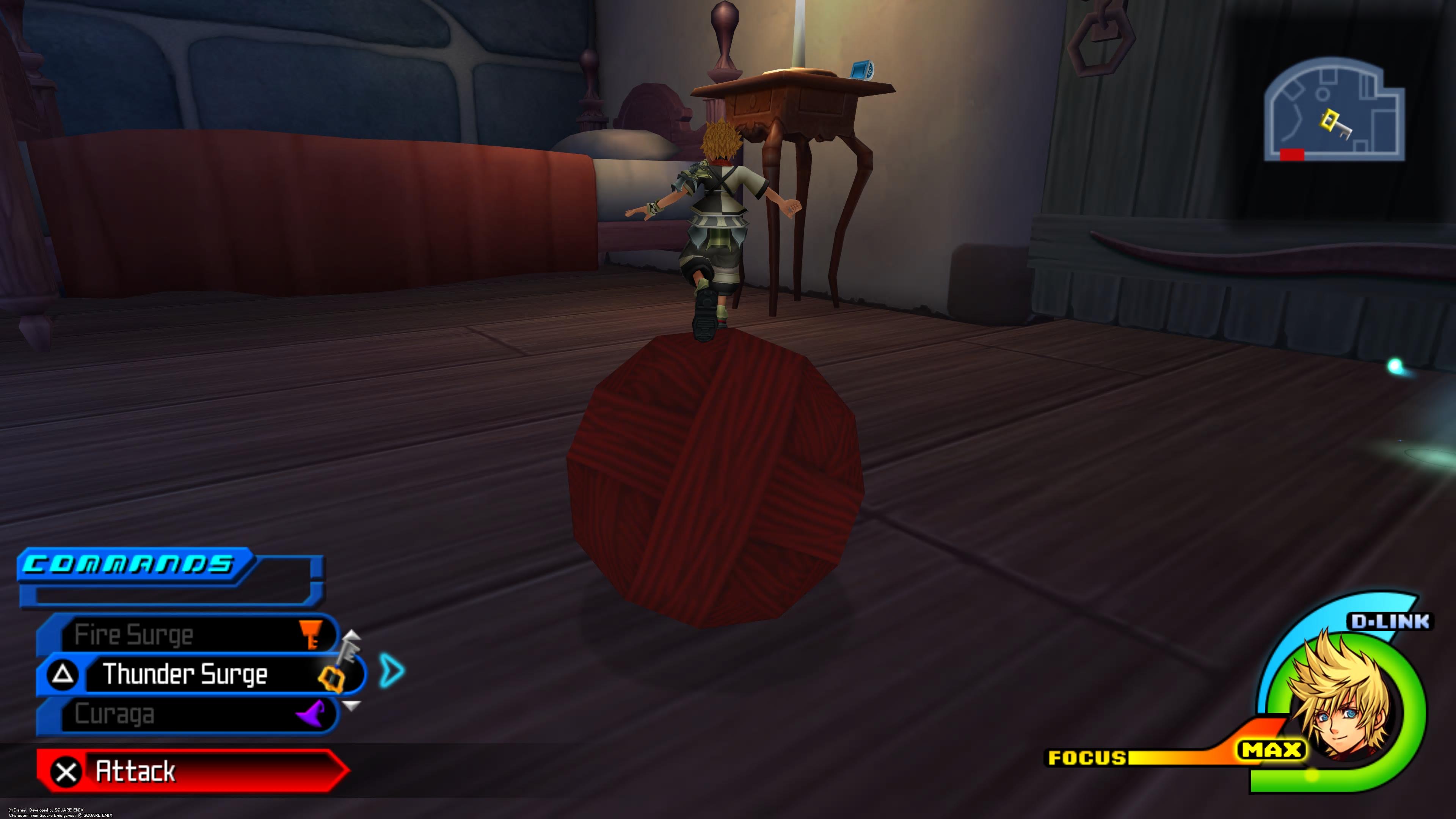
I hate to continue being negative, but when it comes to the worlds in Birth By Sleep, my thoughts on them have also taken quite a dip in the years since I first played the game. To be fair, the worlds here are undeniable improvements over the ones in Kingdom Hearts II in some respects, but unfortunately, these positive aspects are canceled out in crucial ways, resulting in worlds that are ultimately regressions from the ones in Kingdom Hearts II.
Starting with the positives, I like the idea behind the world design in Birth By Sleep. While most of the worlds are straightforward, linear affairs, some of them bring back the interconnected design that made the worlds in the first game feel larger than they actually were. Neverland and Deep Space in particular are two examples of worlds that allow you to loop around them and reach different parts of them in ways that aren’t just going forward or backward. Maleficent’s Castle in Enchanted Dominion is also a great example of a linear space that feels larger than it is because of how labyrinthine the main hall is when playing as Ven. The level of interconnectedness does vary on a character-to-character basis though since Ven, Terra, and Aqua don’t have access to the same areas of each world. While this does mean that some worlds are more basic than others for certain characters, I do still appreciate the attempt that was made towards instilling the worlds with the sense of exploration that they once had.
Platforming and interactivity also see a welcome return across most of the worlds in some neat ways. One room in Radiant Garden features fountains you have to jump on so you can reach the next room and other collectibles. The key gimmick of Deep Space involves turning off the gravity in certain rooms to access areas you would otherwise be unable to reach. Disney Town’s underground section requires you to turn on the power with thunder abilities so you can progress to the next room, as well as play human pinball to get items and reach the rooftops overlooking the raceway. There are also some platforming segments that you can cheat with creative usage of your attack commands to reach sections that would ordinarily be out of reach until later in the game, providing early access to some great moves. The return of meaningful platforming and interactivity is something that I couldn’t be happier about because it brings back some of the charm that was present in the first Kingdom Hearts, but missing from the worlds in Kingdom Hearts II.
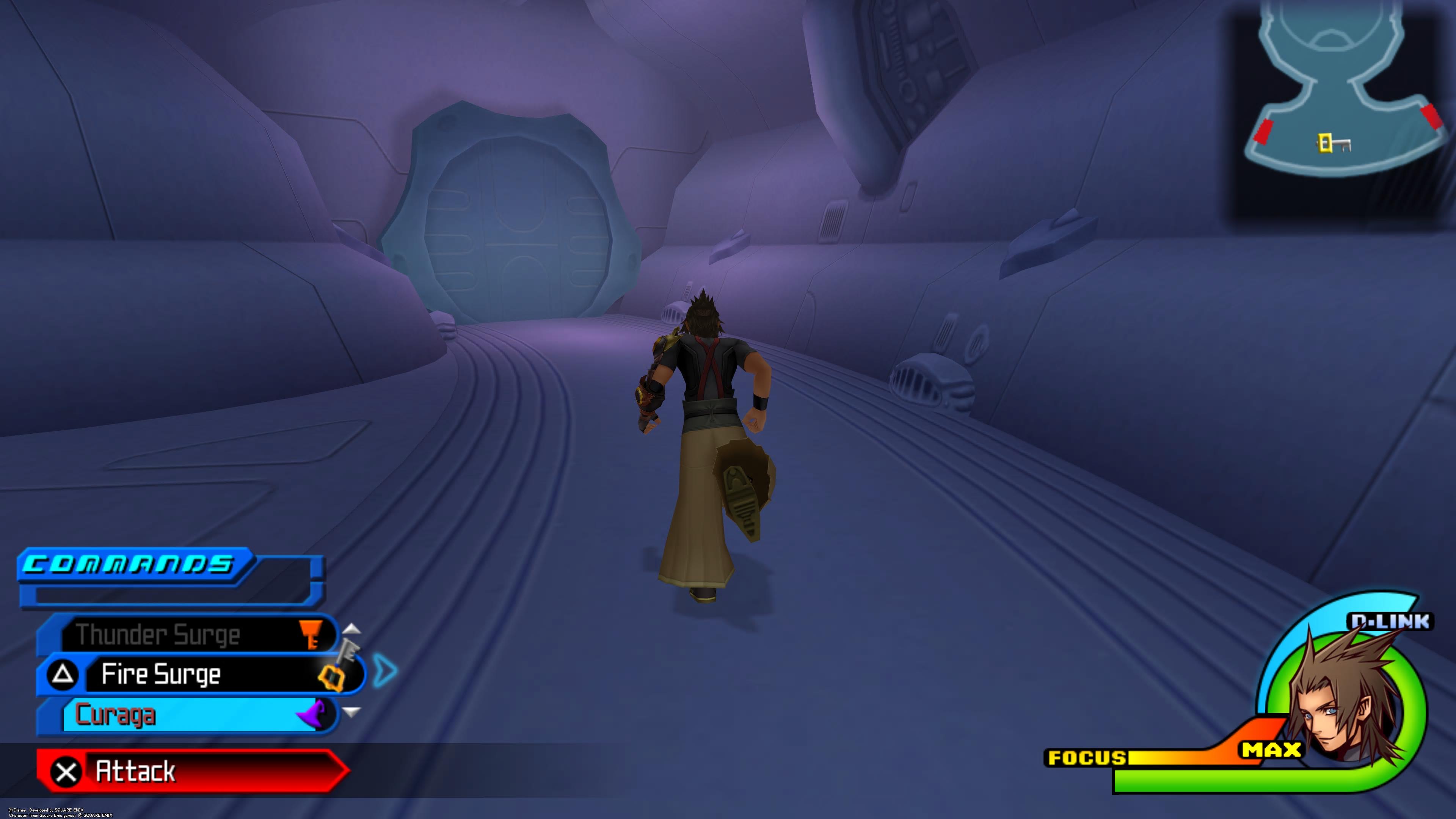
Now I know I’m probably going to get some hate for everything I’m about to say, but as much as the worlds are elevated by the return of these foundational design elements, they’re also handicapped by how lifeless they feel. This is an issue that mostly stems from the lackluster visual aesthetic of the worlds. To be clear, they look fine for the PSP hardware Birth By Sleep was designed for, but playing on a TV at a much higher resolution, the barebones visual design sticks out like a sore thumb. Flat, simplistic textures are everywhere and don’t look that great when blown up on modern displays. Many rooms are simply empty spaces that lack detail and any sort of personality.
These flaws are compounded by the fact that worlds are largely devoid of other characters in places where you’d expect them. To be fair, this is nothing new for the series, but previous games didn’t call much attention to it. Fighting in the coliseum at Olympus now feels extremely awkward since crowds of people are apparently watching us but are nowhere to be seen. The ballroom in the Castle of Dreams is even weirder since there are only six people present in this massive space, yet the Grand Duke speaks as if there are dozens.
This goes into my other problem with the worlds, that being their music. Yes, music is a subjective topic, but to me, the world music is a bit of a mixed bag. A world like Castle of Dreams has great music, whereas Disney Town has the most annoying music in the entire game. But several others have songs that are no better or worse than being just fine. These songs don’t stand out or add any sort of color to the worlds they’re featured in to elevate them in the way that the songs in Kingdom Hearts II elevate their different worlds.
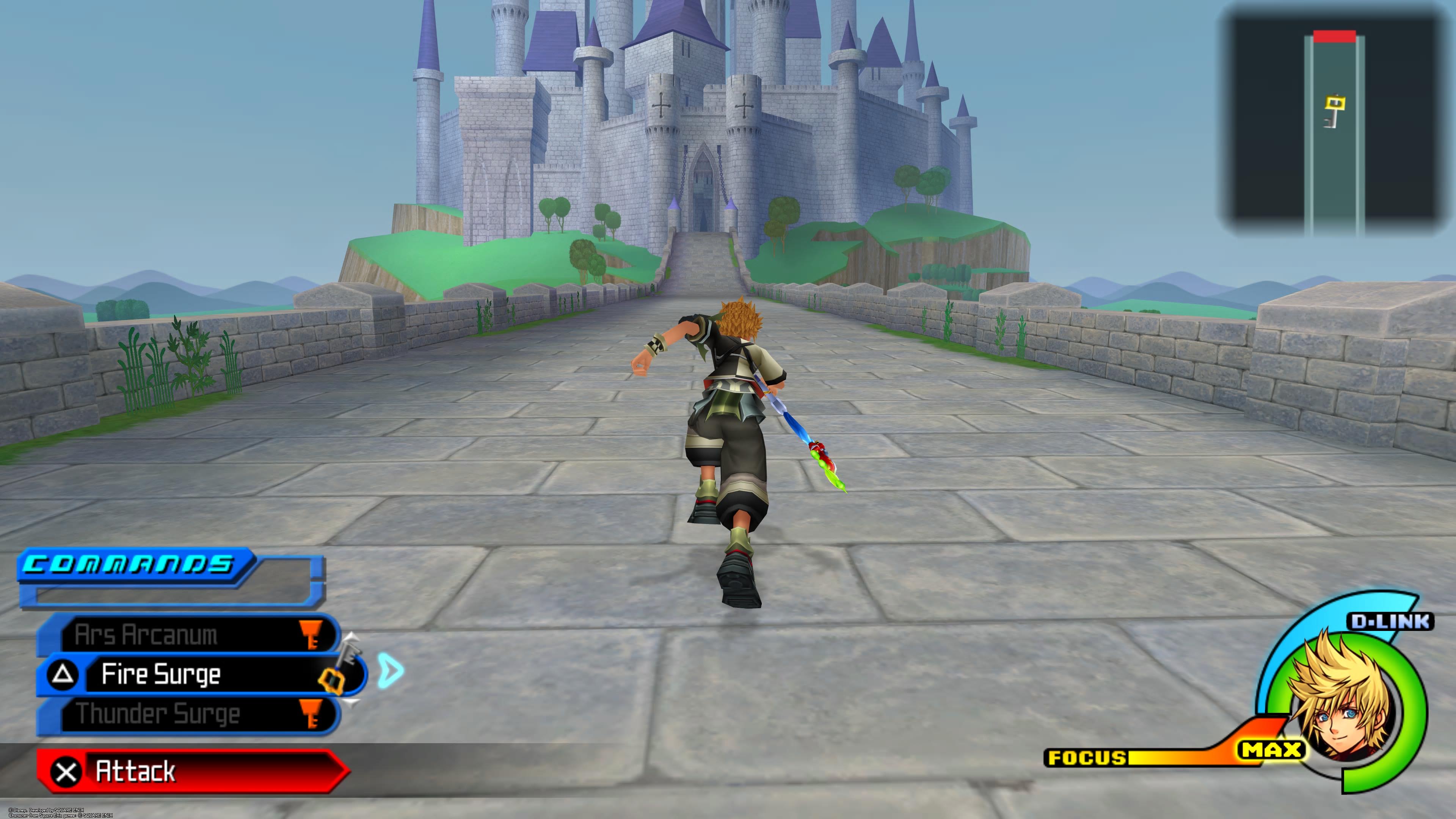
Look at Enchanted Dominion for example. It’s a barren place with a field song that’s just as depressing as the world itself. Emphasizing the sad state of affairs surrounding this world’s narrative is the point of the song, but I find that it makes for an uninteresting gameplay experience when it’s combined with the drab visuals. Being set on an alien ship, Deep Space is a world that should’ve been a home run from an aesthetic perspective, but its flat interiors keep it from being as cool as it could’ve been. Although the field music conveys the intergalactic nature of this world, its simplicity makes it a boring song to listen to and causes the ship to feel emptier than it is. The battle music in both these worlds does bring some much-needed life to them, but it’s not enough to make much of a difference to me overall.
While the return of key design elements from the first game begins to regain the charm and sense of exploration that it excelled at, they’re canceled out by an emptiness that’s pervasive throughout many of the worlds in Birth By Sleep. I don’t want to be too hard on the flaws with the world design because there are technical reasons for it when compared to previous games and it’s not that big of an issue within the context of its original release. I still enjoyed the worlds when I first played the remaster back in 2014, but all this time later, their lifelessness causes them to feel somewhat like abandoned theme parks. They’re alright, but they aren’t quite the exciting and wondrous experience I expect to have when I visit them.
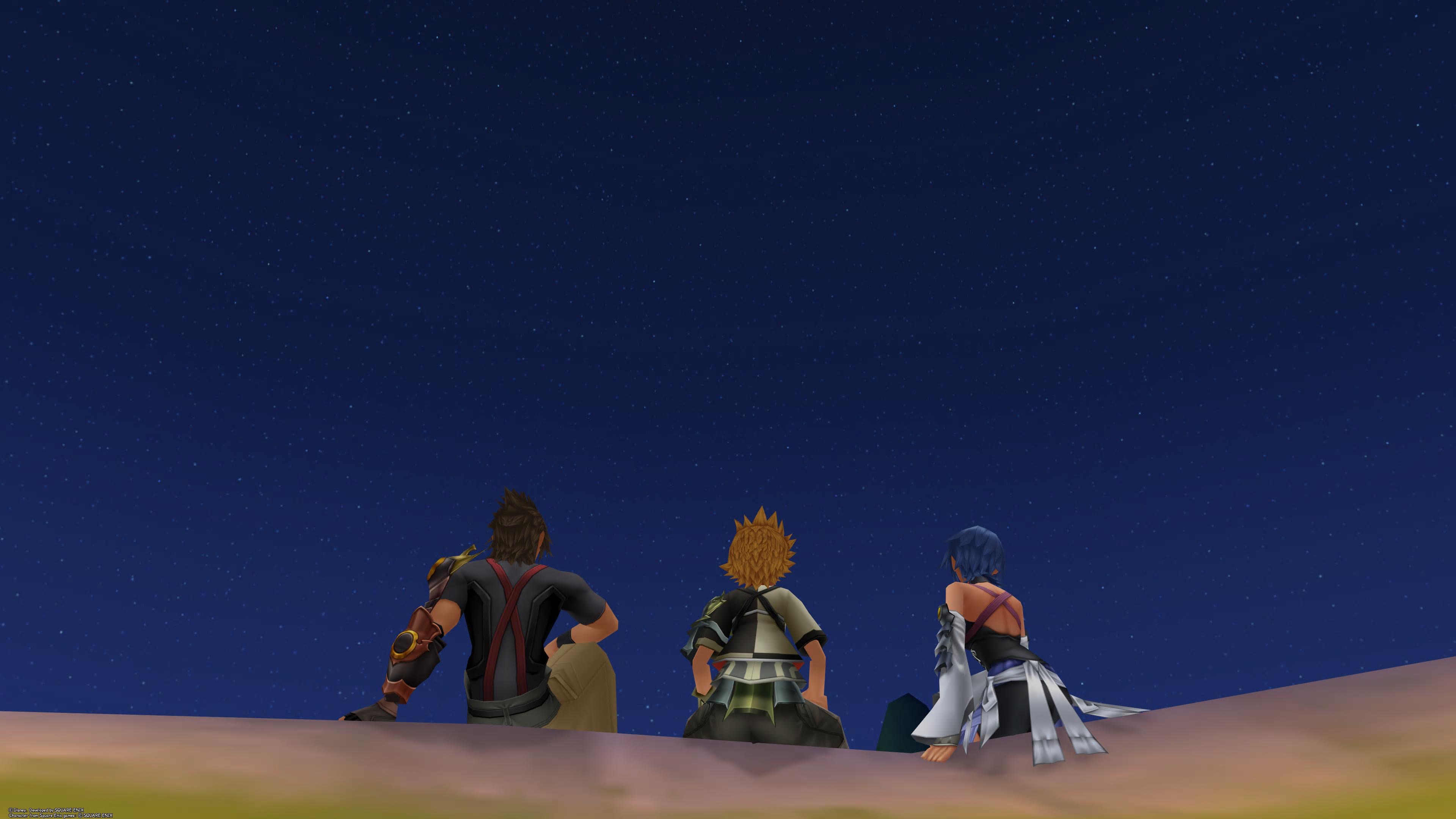
I used to have nothing but love for Birth By Sleep, but now my relationship with it is more complicated. The story is incredible and has become more special to me with this playthrough, but the combat and world design have become more frustrating and disappointing. I appreciate what they bring to the table and how they try to evolve the series, but they come with their own set of caveats that drag the game down. I want to experience the hopeful and tragic story of the Wayfinder Trio, but I’m not interested in the convoluted Command Melding system, the minor and major annoyances that come with combat, or the bland worlds. It’s a shame too because Birth By Sleep is a genuinely good game, that’s even great at times, but now it’s less of a game that I want to actually play and more of a story that I just want to watch.
 TheComfySpot