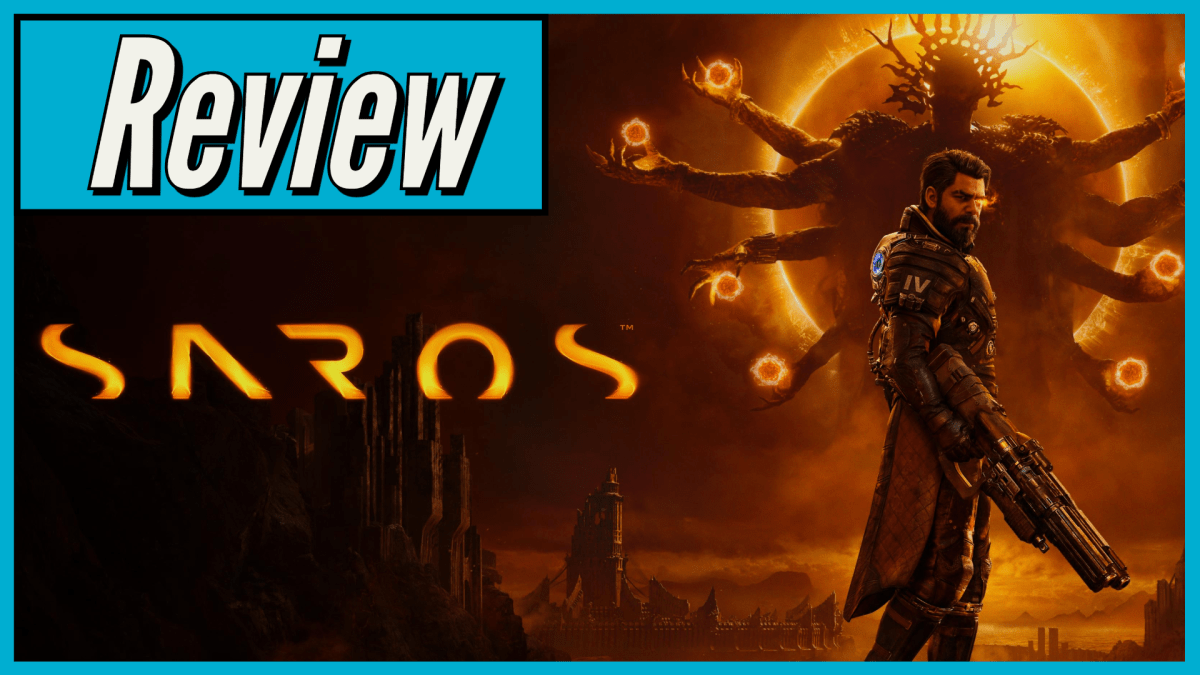
- Developed By: Housemarque
- Published By: Sony Interactive Entertainment
- Reviewed On: PlayStation 5
- Available On: PlayStation 5
There’s no question that everything about Saros is a response to Housemarque’s last game, Returnal. Did you feel like Returnal’s story was a bit too vague? Saros takes the exact opposite approach with its narrative. Perhaps you never got to experience Returnal’s story because of its difficulty. Well, while Saros is no walk in the park, Housemarque has deliberately eased up on the punishment. In many ways, Saros is a better (and arguably more fun) game than Returnal. But in sanding down the edges that made its predecessor so beloved, Saros ends up being the lesser of the two.
Set on the alien planet Carcosa, you play as Arjun Devraj, an Enforcer for the Soltari corporation. After losing contact with the first three groups sent to the planet to set up a mining colony, Arjun’s team, Echelon IV, arrives to find out what happened to them and continue their mission. Meanwhile, Arjun has his own goal of finding a woman named Nitya by any means necessary. Similar to Returnal, the premise isn’t anything complex. However, Saros largely eschews vague, abstract storytelling that leaves much up to interpretation, in favor of a narrative that’s told in a relatively straightforward manner.
Audio and text logs scattered across Carcosa are still utilized to offer tidbits of information both big and small, but many of Saros’ significant story moments come at your base of operations, The Passage. It’s home to each of the major events that push the story forward, as well as separate conversations you can have with Arjun’s teammates about recent events and how they’re holding up. Although we don’t spend too much time with them in the grand scheme of things, I did grow to care about each member of Echelon IV. Rahul Kohli absolutely shines, though, in the lead role. Arjun isn’t some valiant knight in shining armor. He’s a flawed individual who’s focused solely on what he wants, and Kohli imbues Arjun with the desperation and intensity of a man who will stop at nothing to see his goal come to fruition.
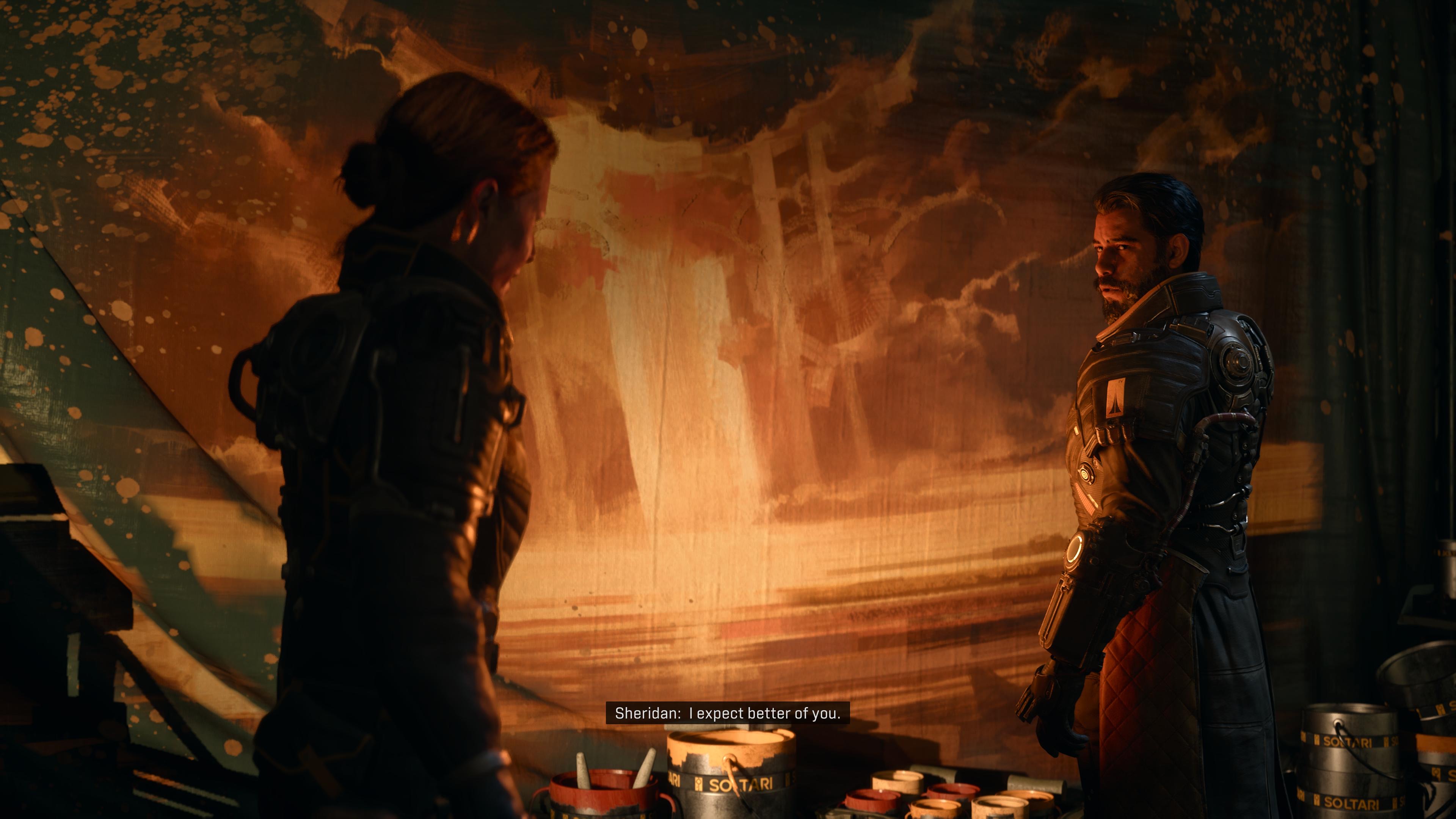
Ironically, it’s possible to miss out on some of these fireside chats if you don’t die much while advancing through the story. I died a total of 19 times before rolling credits on the true ending, with most of them happening in what I’d consider the first half of the game. Between those deaths and the times I voluntarily returned to The Passage after completing a biome, I feel like I got the whole picture of these events, but I wouldn’t be surprised if there were a few more scenarios I missed in the back half of the story.
Frankly, if we were to compare the stories in Returnal and Saros, I don’t think I would say that one is necessarily better than the other. Nevertheless, I do prefer the narrative changes Housemarque made here. Don’t get me wrong, I thought the ominous ambiguity of Selene’s ordeal on Atropos was compelling. But shifting to something more clearly defined and directed caused me to be more invested in the story that Saros was telling.
This isn’t to say that Saros lacks the persistent air of mystery that helped make Returnal’s story so engrossing. Carcosa is a planet that gradually twists the minds of those who inhabit it. Desires become obsessions, fears and anxieties become weaponized. Because it’s never made clear just how much time has passed between runs, I was frequently wondering whether certain events were actually happening, or if they were a result of Arjun himself falling victim to Carcosa’s siren call as the situation became more dire and his fixation grew stronger. Dream-like sequences that cryptically reveal details of Arjun’s past also contribute to his dwindling credibility, causing his perspective to appear even more unreliable.
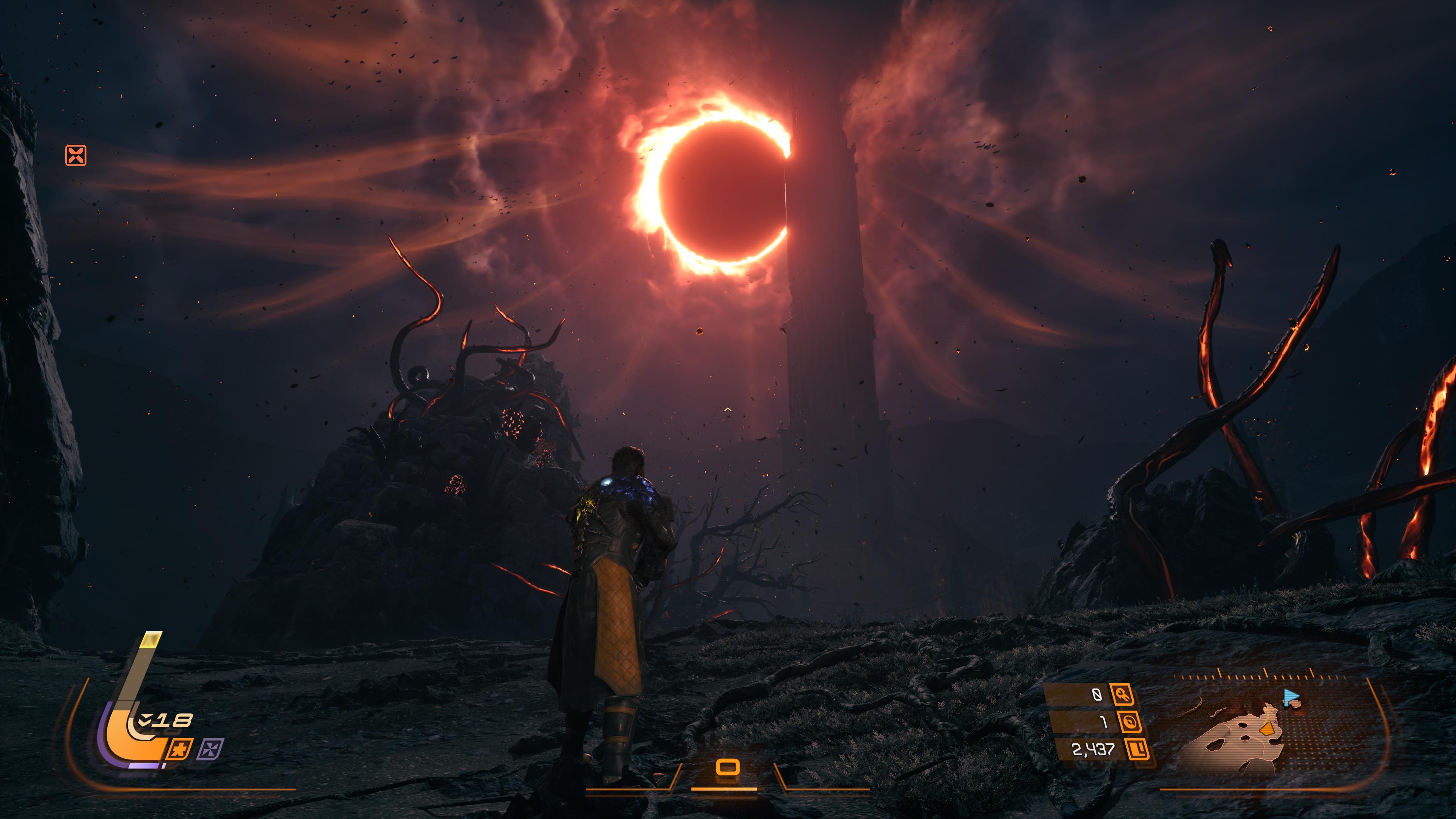
Then there’s Carcosa itself and its history, both of which I found to be deeply fascinating. I loved exploring each biome and coming across rooms with massive smoke clouds that portrayed a brief moment from Carcosa’s past, offering insight into how the planet got to its current state. Looking at the statues across the planet, I couldn’t help but be disturbed and enthralled by how they appear to have been made out of bodies that were merged together. Once Saros’ signature eclipse is triggered, Carcosa comes to life in unexpected ways. Tendrils spring into action. Once safe waters become corrosive. The cold depths become an active foundry. War breaks out at a long-destroyed fortress. All the while, the mesmerizing eclipse hangs in the air like the eye of Sauron, overseeing all and beckoning you forward.
I really enjoyed the mysteries that Saros presented throughout its story, and was always eager to find out more about what was happening on Carcosa. By and large, the most important loose ends and lingering questions are definitively answered, leaving little room for misunderstandings once you reach the story’s conclusion. That said, some elements of the overarching narrative do remain open for interpretation, and it’s been fun seeing the fanbase speculate on these various details.
As I said at the top of this review, Saros is a response to how people felt about Returnal, and nowhere is that more true than in the core gameplay. Saros is still plenty challenging, but it’s not punishing. Instead of making you feel like a survivor, Saros wants you to feel like a conqueror. To fit this new design philosophy, Housemarque has evolved and refined the mechanics they introduced in Returnal, and amplified the challenge. At the same time, they’ve also made things a bit easier, for better and for worse.
The primary reason Returnal was so punishing was the length of its runs, and the fact that at launch, there was no way to stop playing without losing your progress. Saros addresses both issues by having a suspend and quit function on day one that allows you to leave the game and keep your run progress saved, so long as you aren’t in the middle of a boss fight. Being able to teleport back to The Passage at the end of each biome also allows you to make a run as long or as short as you want. Even better is being able to use the teleporter to start your run at any biome you desire. Not having to start a run all the way from biome 1 if you died in biome 5 is great for story progression, but it’s even better for collecting resources and opening paths that were once inaccessible after gaining a new traversal ability. Sure, these changes make things easier, but they’re welcome ones that we can all benefit from.
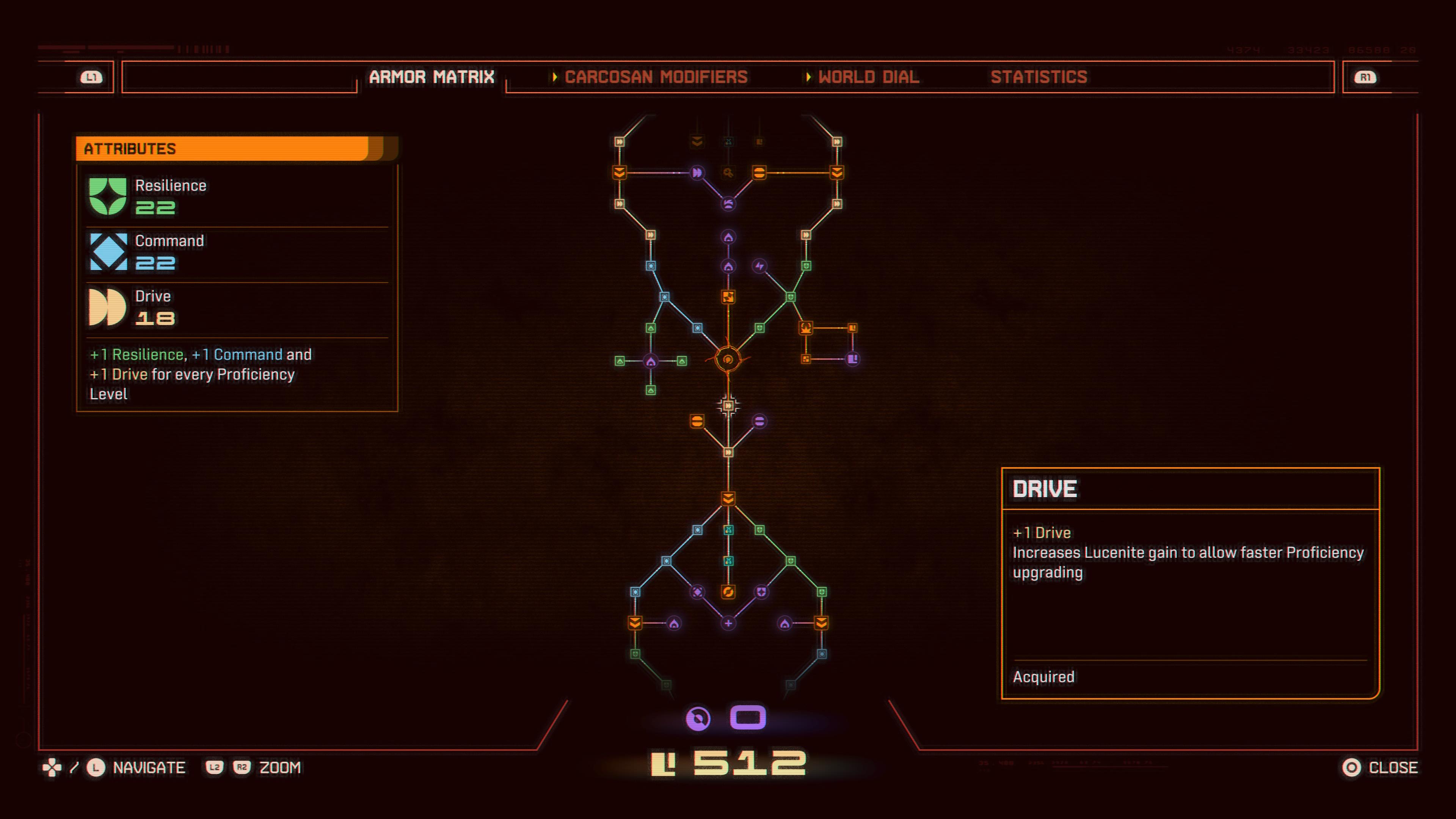
One of the biggest changes is the addition of permanent upgrades that persist beyond runs. Back at The Passage, you can access a progression tree called the Armor Matrix. It’s filled with stat boosts for your health, power, and Lucenite gain rate, along with upgrades to things like your starting Proficiency level and how staggered an enemy becomes after performing a parry. Perhaps the most important of these is the Second Chance upgrade that gives you another opportunity to continue the fight if enemies get the better of you during a run. These upgrades are unlocked with Lucenite and a rare resource called Halcyon that can occasionally be found during a run. If you’re worried that having these persistent upgrades will make you feel overpowered as you progress through the story, worry not, since they merely keep you up to par with the difficulty of the biomes you’ve unlocked. You can also only advance so far in the Armor Matrix since access to new segments is gated by defeating the next Overlord in the story.
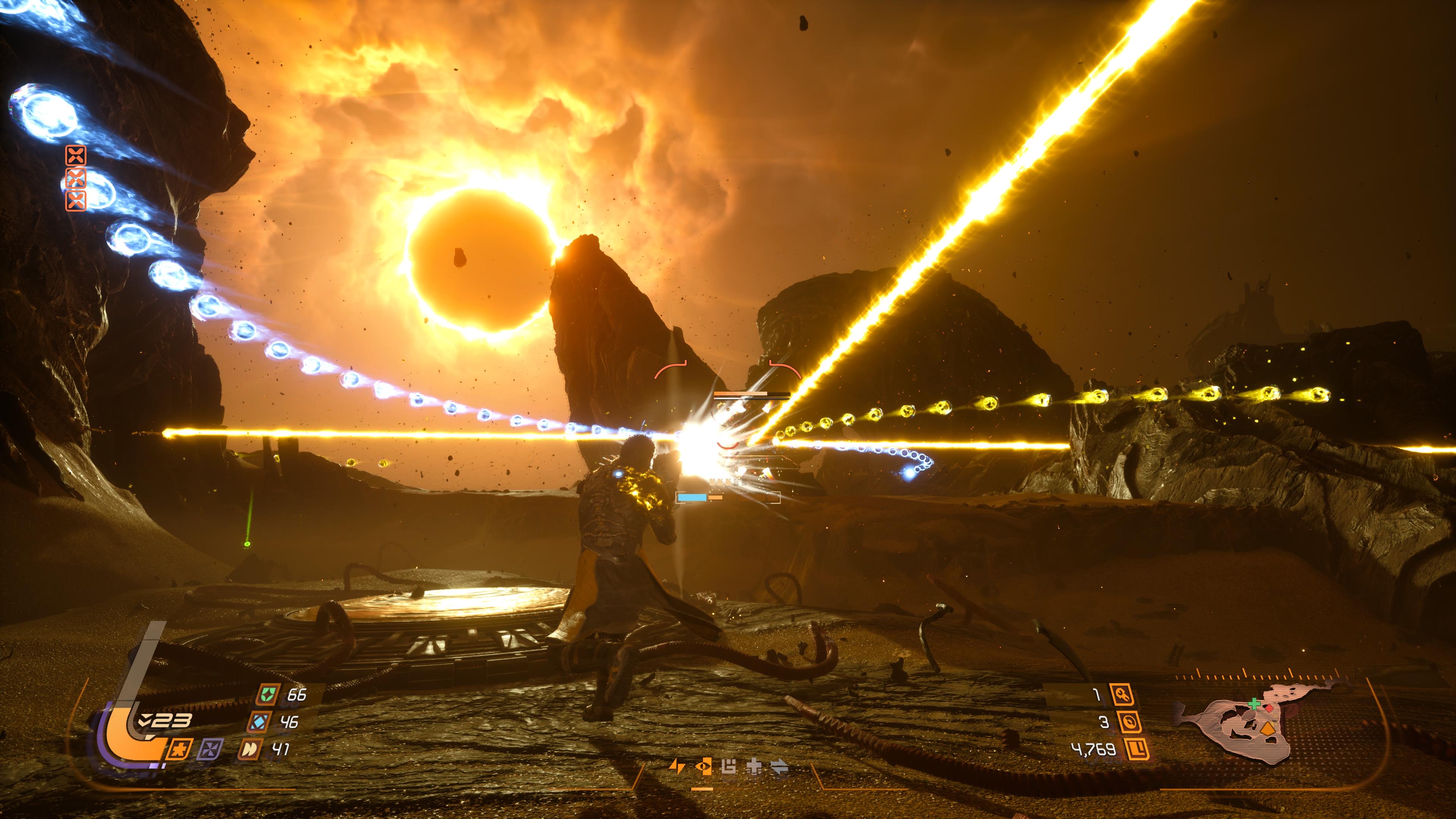
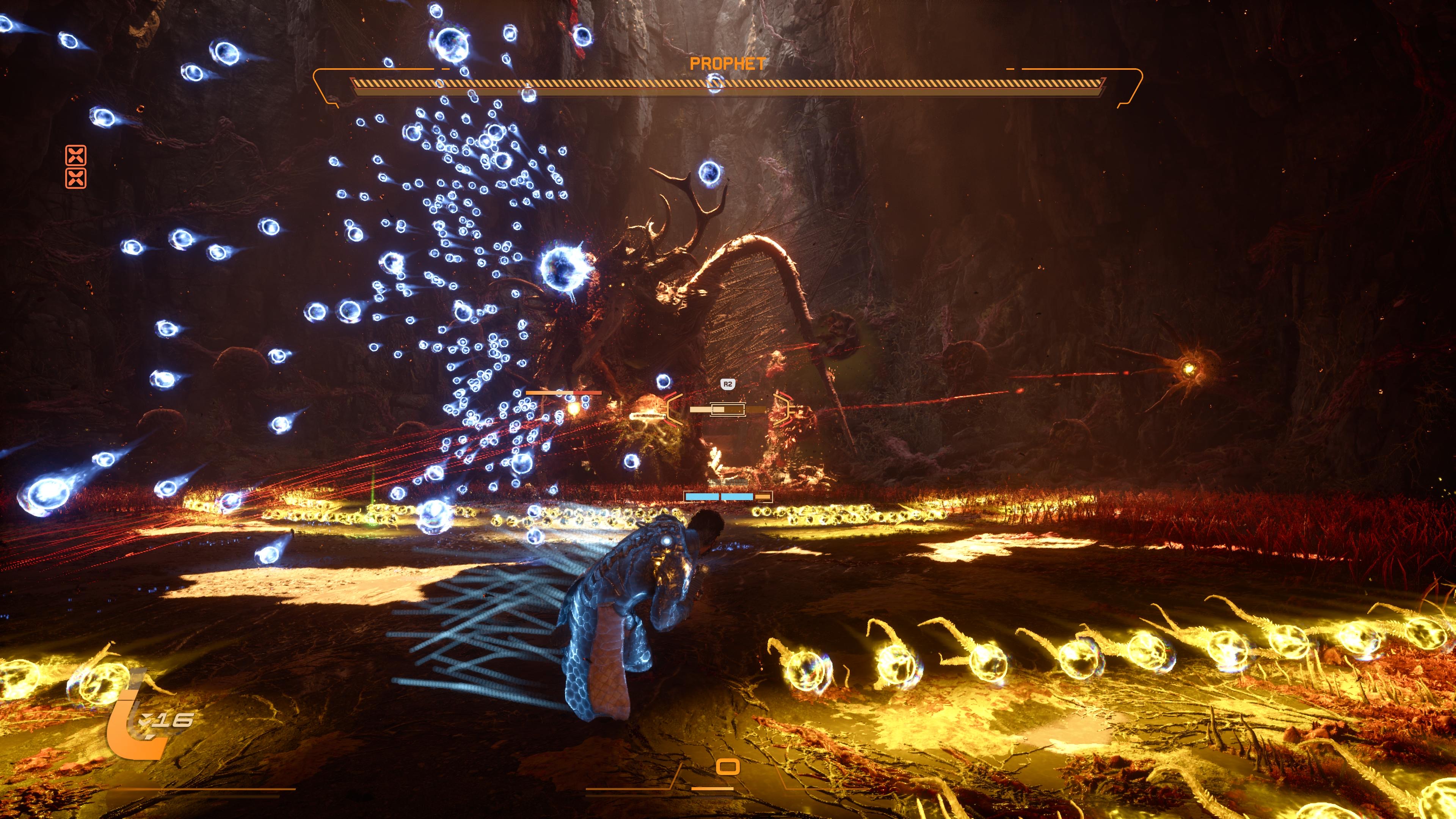
Combat is where Saros truly excels and proves its worth as a top-notch action game. Enemies are aggressive and decorate the screen with more colorful orbs and lasers than I ever remember dealing with during standard fights in Returnal. Here, you’re given reasons to consider facing them head-on instead of only dodging them. Blue orbs deal damage, but absorbing them with your shield protects you and recharges your power bar. Red orbs can’t be blocked, but they can be parried with a well-timed melee hit. Yellow orbs don’t directly damage you and instead override your maximum health with corruption that can only be removed by using your power weapon. Being corrupted is normally a bad thing, but once you unlock weapon variants that deal more damage based on how much corruption you’ve accrued, it becomes a risk to consider taking.
There’s a lot to think about, and it can be overwhelming to have enemies with different movesets send all kinds of multi-colored barrages at you from all sides, yet it was a challenge I always welcomed with a smile on my face. I love how it adds depth to the bullet hell gameplay that Housemarque is known for, encouraging me to remain alert and not just stay on the defensive, but to turn that defense into offense so I can take control of battles.
This is especially the case when going against the Overlords at the end of each biome. As one would expect, they dial the pressure up to 11 and demand that you bring your A-game to progress. The disappointment that comes from dying so close to the end of these fights is only matched by the immense satisfaction that comes from eeking out a victory when death seemed inevitable. Thankfully, if you end up dying, you’ll revive at The Passage with the weapons you had in your possession. It’s another change that some might feel is too forgiving, but I think it’s a great choice to start your next run on a better foot than your last one.
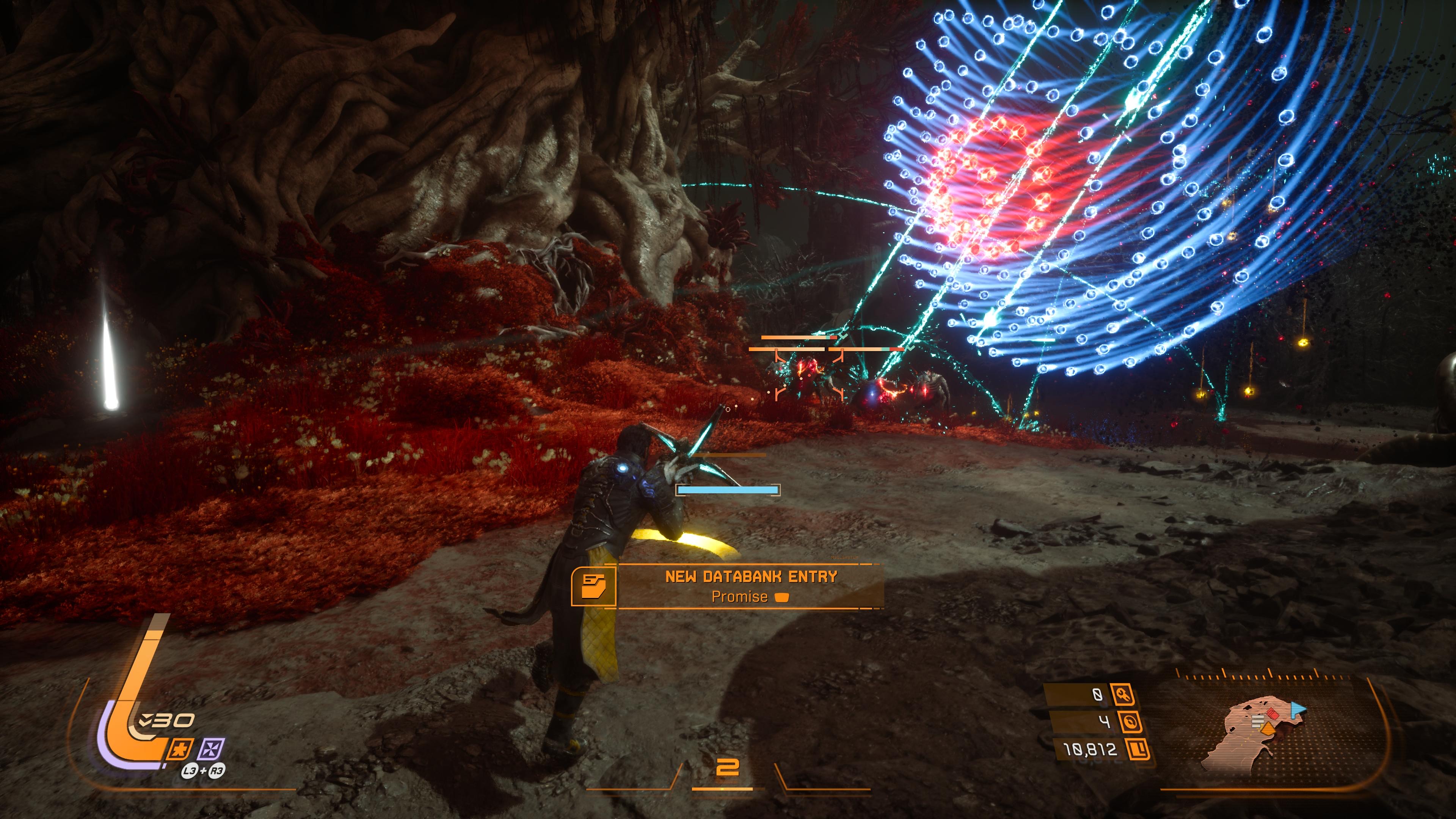
Speaking of the weapons, Housemarque has once again done a great job of creating an arsenal that’s wildly fun to use and largely easy enough to pick up and understand within minutes. On its face, having only five weapon types doesn’t seem like much variety, but each weapon has three variants that change how it operates, making for a total of 15 weapons to choose from. And that’s not even mentioning the different traits that amplify your weapon’s effectiveness. The team also continues to leverage the DualSense’s adaptive triggers in creative ways. If you don’t press L2, your gun uses its primary firing mode. Hold it down halfway, and you’ll trigger the weapon’s alternate firing mode.
The Horde Shotgun, for example, ordinarily shoots in a horizontal spread and changes to a more concentrated vertical spread with its alternate firing mode. On the other hand, the Annihilator Shotgun turns into a grenade launcher with its alternate firing mode, allowing you to easily stagger enemies for quick one-hit melee kills. One of my favorites was the Ricochet Handcannon since its alt-fire not only let me shoot as fast as I could pull the trigger, but, as the name implies, its bullets bounced off walls and enemies, letting me clear entire rooms with ease. Another favorite was the Repeater Crossbow (or as I like to call it, the Electropylon Driver 2.0). This auto-fire weapon normally shoots out bolts in a wide spread, and its alt-fire shoots a single bolt that splits into multiple homing bolts after hitting a wall or enemy. It’s a strong weapon when you first find it, but once your proficiency is high enough and it’s stacked with a full set of traits, it absolutely melts everything in its path.
Rounding out your arsenal are power weapons. Activated by pressing down fully on L2, these more than live up to their namesake. They can’t be spammed endlessly since usage of these weapons is governed by how much power you have, but they’re invaluable in getting out of a tight jam and giving yourself a moment to breathe. The same goes for your Overdrive attack, which takes even longer to charge up and deals even more damage. You’ll also come across artifacts that grant buffs such as increases to your stats, more effective health pick-ups, or being healed by killing enemies. You can hold a good number of these, with upgrades from the Armor Matrix raising the amount of artifact slots Arjun has, so you’ll find a lot during your runs.
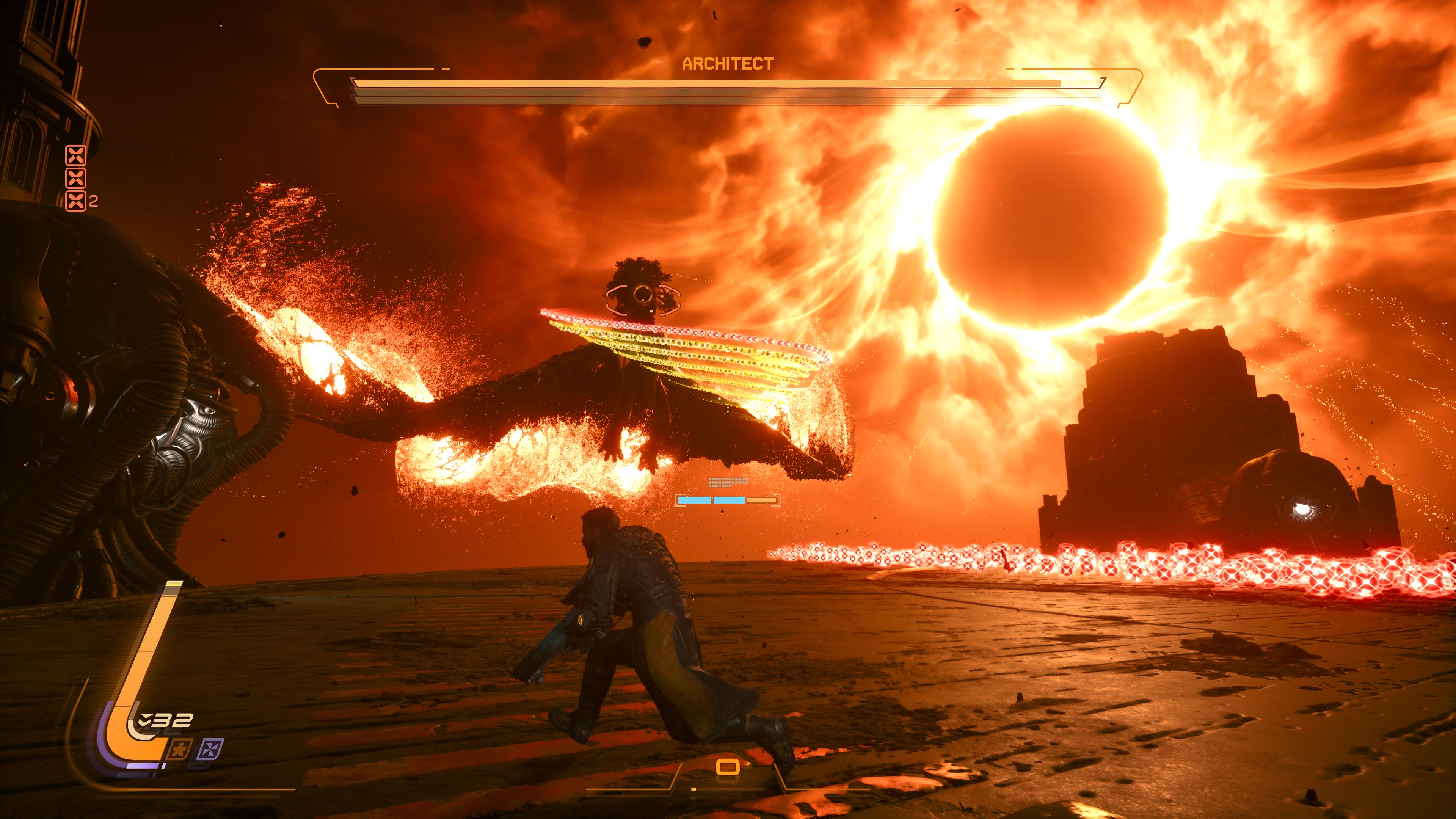
You see, although Saros is a more challenging game than Returnal, the tools on offer here highlight the key difference between the two. The latter was a game that pushed you to survive. No matter how many runs you did in Returnal, you’d regularly find yourself fighting for dear life and pulling out every trick in the book to make it to the next room in the hopes that you’d get some more health.
Such a scenario is still possible in Saros (most notably when tackling the Nightmare Strand challenge rooms and the Overlords), but the systems and mechanics here push you to thrive. They empower you in a way that flips the roles and gradually makes you a force to be reckoned with. It wants you to be dashing and bounding around the space with guns blazing while avoiding attacks, charging towards foes as you absorb their projectiles, using that energy to fire off your power weapon, blasting another group of enemies with your primary weapon, then zipping across the room to perform a melee attack on a distant staggered enemy. By the time I reached the final biome, it was no longer a question of how I’d survive, but how I’d obliterate every creature Carcosa threw at me in one fast-paced, white-knuckle battle after another that always had my brain operating on overdrive.
Where Saros begins to falter is in its roguelike systems, which are lacking in comparison to Returnal. The rooms in each biome are now less partitioned by doors and more seamlessly connected, creating a feeling of free and open exploration throughout the planet. There are also some pathways that are only accessible during the eclipse, which gave me more reason to activate it at the start of a biome when given the opportunity. I quite liked this sense of boundless discovery during my first few runs of each biome since it added to my immersion, but as I reached the endgame, the lack of segmentation started to detract from the experience. The reason being that there’s less randomness in the rooms you come across in each biome. When there’s less randomness, and you can always see the room ahead of you, runs become exercises in familiarity. There’s power in the few seconds of mystery surrounding what’s in store for you next, and Saros doesn’t have it.
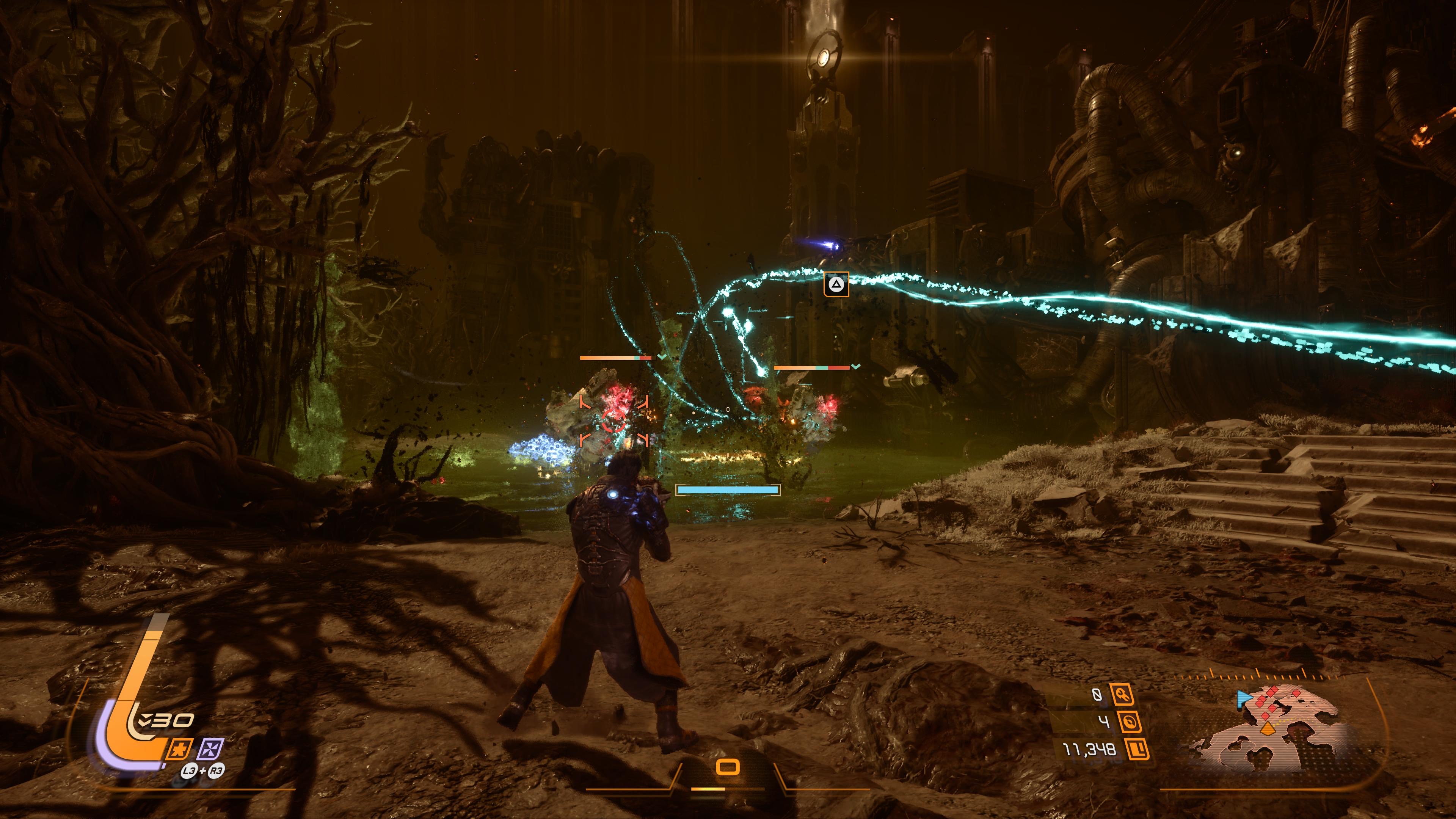
I mentioned before that you come across a lot of artifacts over the course of a run, and on one hand, it’s cool to be essentially drowning in riches. However, on the other hand, it dilutes the impact of finding them. Once you activate the eclipse, artifacts become like the parasites in Returnal and gain debuffs called corruption effects. Sadly, the pairing of buffs and debuffs isn’t the best. Sometimes the buff was minor enough that it didn’t matter whether I took the artifact. Other times, the buff was really good, and the debuff was something inconsequential, like taking fall damage or dealing less damage while standing. Then there are the debuffs, such as having longer dash cooldowns or dealing less damage at low health, that are obviously not worth the minor buff they’re typically paired with. For the majority of the game, I rarely felt a strong push-and-pull between whether or not I should take an artifact.
The notable effects that came with parasites and the fact that you could only have a maximum of five meant there was significant weight behind choosing one in Returnal. All such weight has been removed in Saros, causing artifacts to play second fiddle to your weapon choice. Instead of being real game changers with a major impact on the rest of your run, they feel more like slight enhancers. This is doubly the case since the corruption effects of any artifacts you have are cleansed and removed after defeating an Overlord, so you keep all the benefits and none of the detriments. I get Housemarque wanting to make Saros more approachable to those who felt Returnal was too difficult, but this change sands away some of the edge that made runs in their last title so enjoyable.
It isn’t until late in the story when your stats are high enough that Saros actually adds weight to artifact choices with the introduction of Volatility. Picking up artifacts will come with a chance of pushing your Drive, Command, and Resilience attributes over their limit and making them volatile. Depending on the volatile attribute, you either won’t be able to view enemy health, won’t see corruption effects on artifacts, or will lose all your collected Lucenite upon death. With such high stakes, the risk of triggering these debuffs made me weigh my options carefully after several hours of not having done so prior. Although it makes sense to hold back on the more punishing systems so that more people can see Saros through to completion, I wish this one had come sooner.
If you want to make the experience more difficult for yourself, that’s when you turn to the Carcosan Modifiers. These allow you to make runs more challenging by tweaking things such as enemy damage output, corruption accumulation, the strength of your own weapons, or even turning off the upgrades you get from the Armor Matrix. Conversely, some modifiers make runs easier. You can only apply six of each type of modifier, and they all have a cost, with stronger ones costing more points, so you can’t just apply as many as you want. Saros also maintains a minimum level of difficulty by requiring your modifiers to remain in balance, or, if you’re a glutton for punishment, letting you tip the scales wildly in favor of your adversaries. There’s a setting that you can disable if you want the game to be underleveled so you can steamroll everything that crosses your path, but Housemarque is pretty clear that it’s not the intended way to play.
I went through roughly half the campaign without using any modifiers before turning some on in the last half of the story, and found it to be a respectable challenge both ways. Even though the overall balance of my modifiers tilted things a bit more in my favor, I still had my fair share of close calls, so I never once felt like Saros became too easy or too hard as I made my way to the story’s conclusion. They’re a neat way to fine-tune the experience, and completely open the doors for different kinds of challenge runs once you roll credits. Still, it’s disappointing that there’s no incentive to overload the negative modifiers. I know that some out there live for the whole “make your own fun” philosophy. I, too, can be that person at times, but I still need something to push me over the edge. Something to say, “Why don’t you give this a shot and see how exciting this can be?” Offering more upgrade resources for the Armor Matrix would be a great incentive for completing these types of runs, especially since Halcyon is needed to unlock many late-game upgrades.
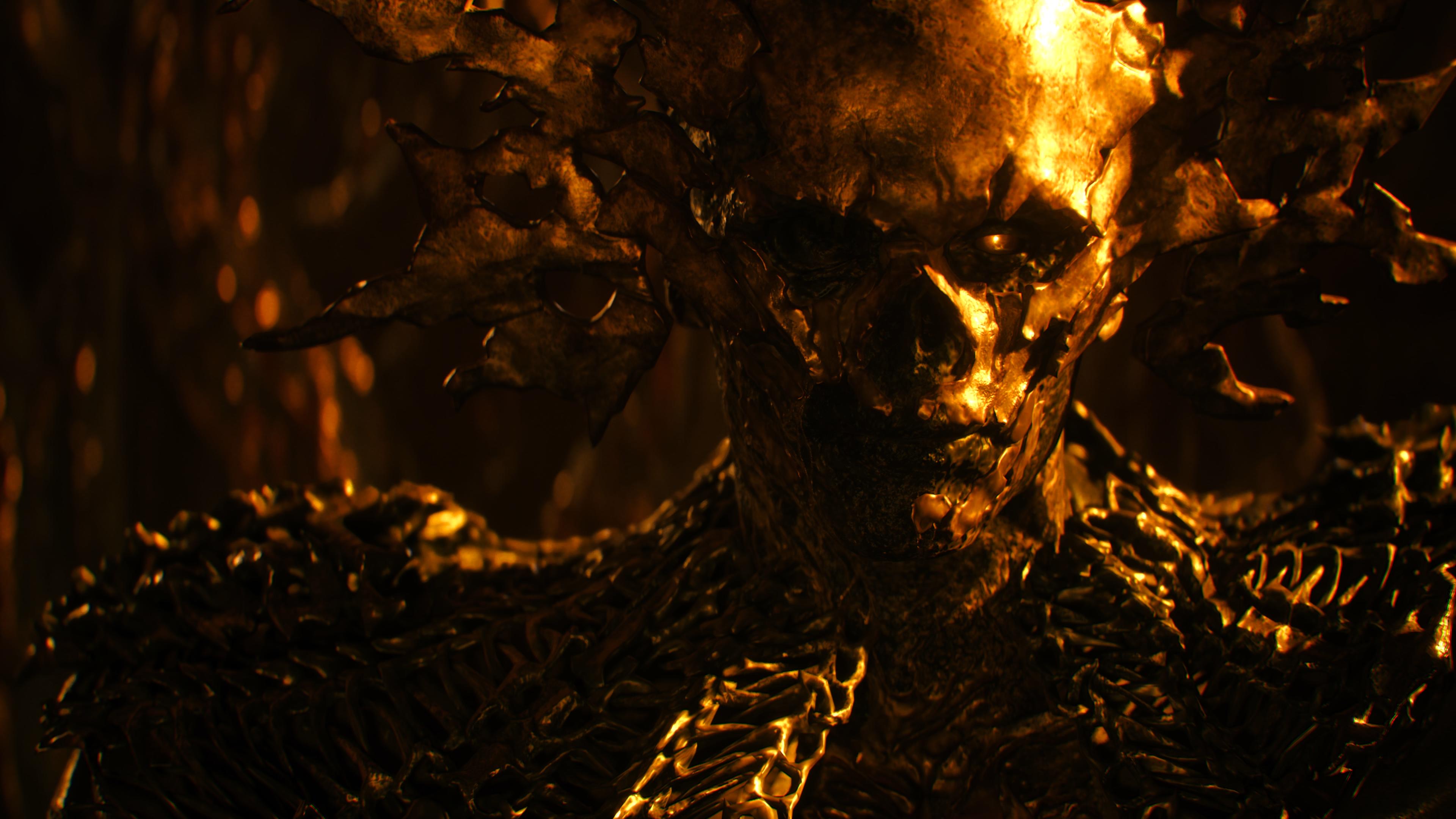
All of these flaws come together to create my biggest disappointment with Saros: the lack of replayability. Upon completing the story, all that’s left to chase are the final upgrades in the Armor Matrix and any remaining audio and text logs. Beyond that, unless you start a new save file, it’s up to you to “make your own fun.” Returnal was no stranger to this either (especially before the Tower of Sisyphus was added as post-release content), but the strength of that game’s systems made doing subsequent runs continue to feel like an exciting endeavor. With Saros, the only excitement stems from how enjoyable combat is.
I love the biomes, but they quickly become very familiar to progress through. Artifacts barely have weight behind them, so they just become things to grab and make you stronger than you already are. Since you’re essentially a one-man army, the challenge becomes one you have to place on yourself through modifiers or other self-imposed rules. And with nothing to strive for in these new runs, the only reason to do any of this is purely for the love of the game. I have love for Saros, but not enough to do more than two post-game runs right now.
Overall
When Saros is firing on all cylinders, it’s a great game. But through a combination of the watered-down roguelike systems and nothing meaningful to chase upon completion, any desire to spin the block on Carcosa has largely been ripped away. It’s a testament to the inventive gunplay, exhilarating combat, and compelling story that these issues largely fade into the background when you’re in the midst of battle, moving from one fight to another. Saros might not keep you around for a long time, but it’ll show you one hell of a good time.
 TheComfySpot